

The AI buildout started out funded mostly from the operating cash flow of the largest technology companies. During 2025 and 2026 it moved onto borrowed money: corporate bonds, project bonds issued by special-purpose vehicles, bank construction loans, and private credit secured on GPUs. The sections below set out how much has been borrowed, where the debt sits, and what has repriced during 2026.
Summary
Bond issuance by Alphabet, Amazon, Meta, Microsoft and Oracle was $132 billion in the first seven months of 2026. It was $93 billion in all of 2025 and averaged $35 billion a year in 2020 to 2024.
Total AI-related debt issued in 2026 had passed $466 billion by late October, according to Forbes. Morgan Stanley’s forecast for the full year is about $570 billion.
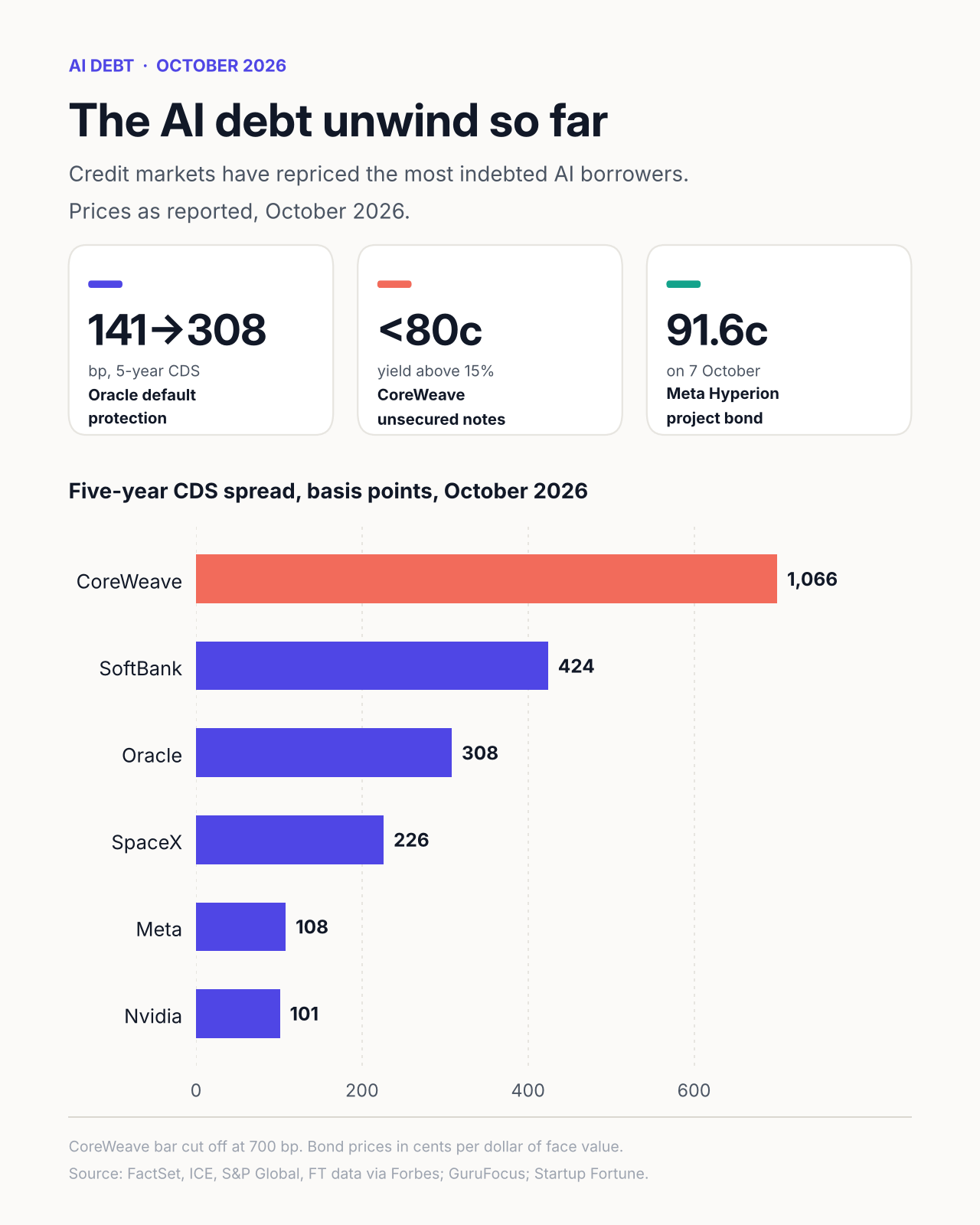
The largest moves have been in the most indebted borrowers. Oracle’s five-year credit default swap (CDS) spread rose from 141 basis points (bp) on 2 January to 308 bp on 21 October. CoreWeave’s peaked at 1,195 bp on 15 October.
Off-balance-sheet structures are also repricing. The $27.3 billion bond that financed Meta’s Hyperion data centre traded near 91.6 cents on the dollar on 7 October.
Broad credit spreads have widened from near their lows, but less than in April 2025. US high yield spreads were 340 bp on 22 October, 80 bp above their 2026 low.
How much has been borrowed
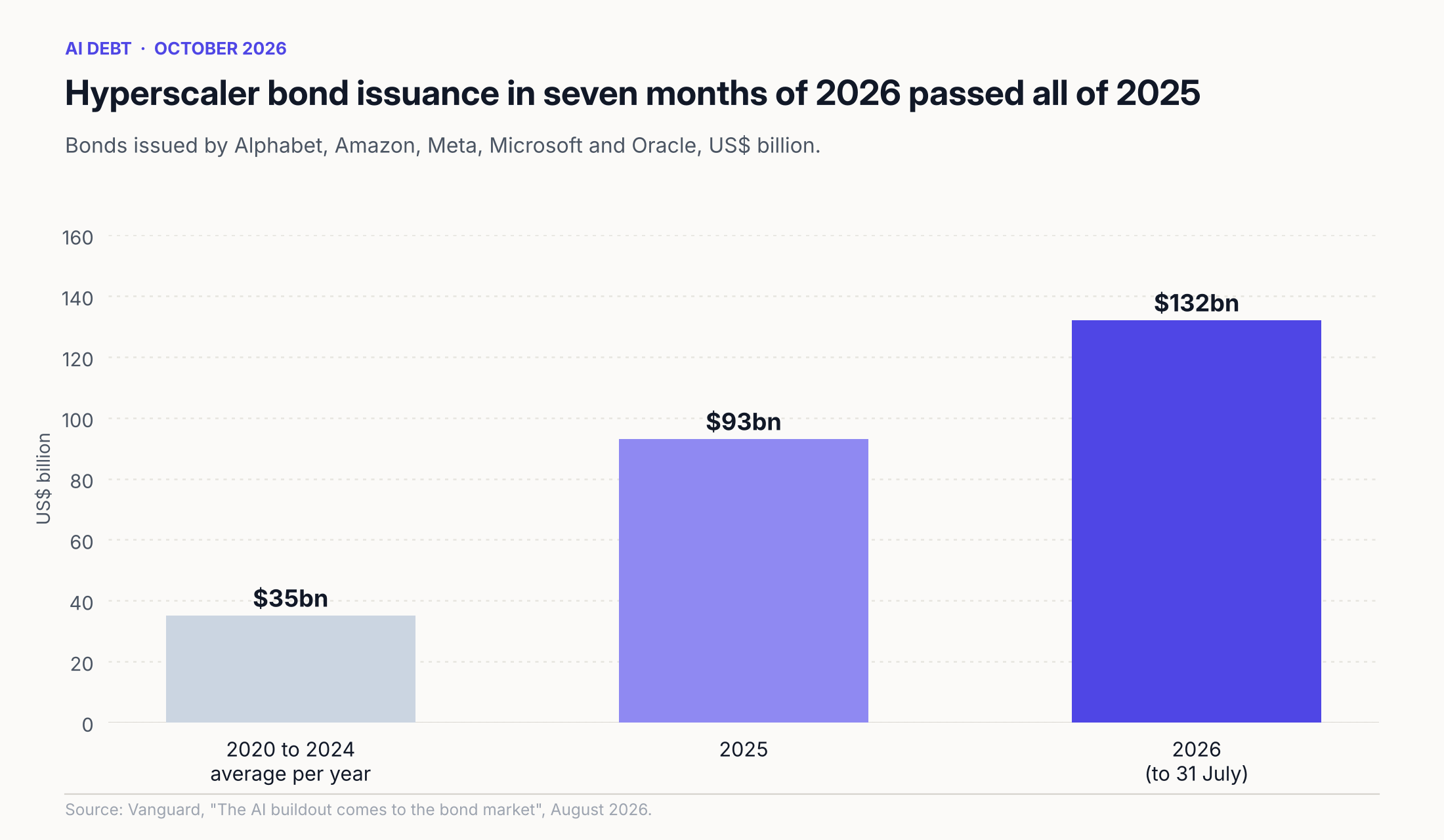
The five largest cloud and AI spenders issued about $35 billion of bonds a year from 2020 to 2024. In 2025 they issued about $93 billion. By the end of July 2026 they had issued $132 billion, including one offering of about $53 billion. Consensus estimates cited by Vanguard put their combined capital spending for 2026 at close to $800 billion.
Vanguard puts total AI-related debt issuance for 2026, including chipmakers, data centre developers and utilities, at roughly $300 billion to $570 billion. The upper figure is Morgan Stanley’s forecast, and about $236 billion of it had priced by 31 May. Forbes reported that more than $466 billion had been issued in 2026 by late October. Goldman Sachs expects hyperscaler issuance alone to reach $420 billion in 2027, 60% more than in 2026.
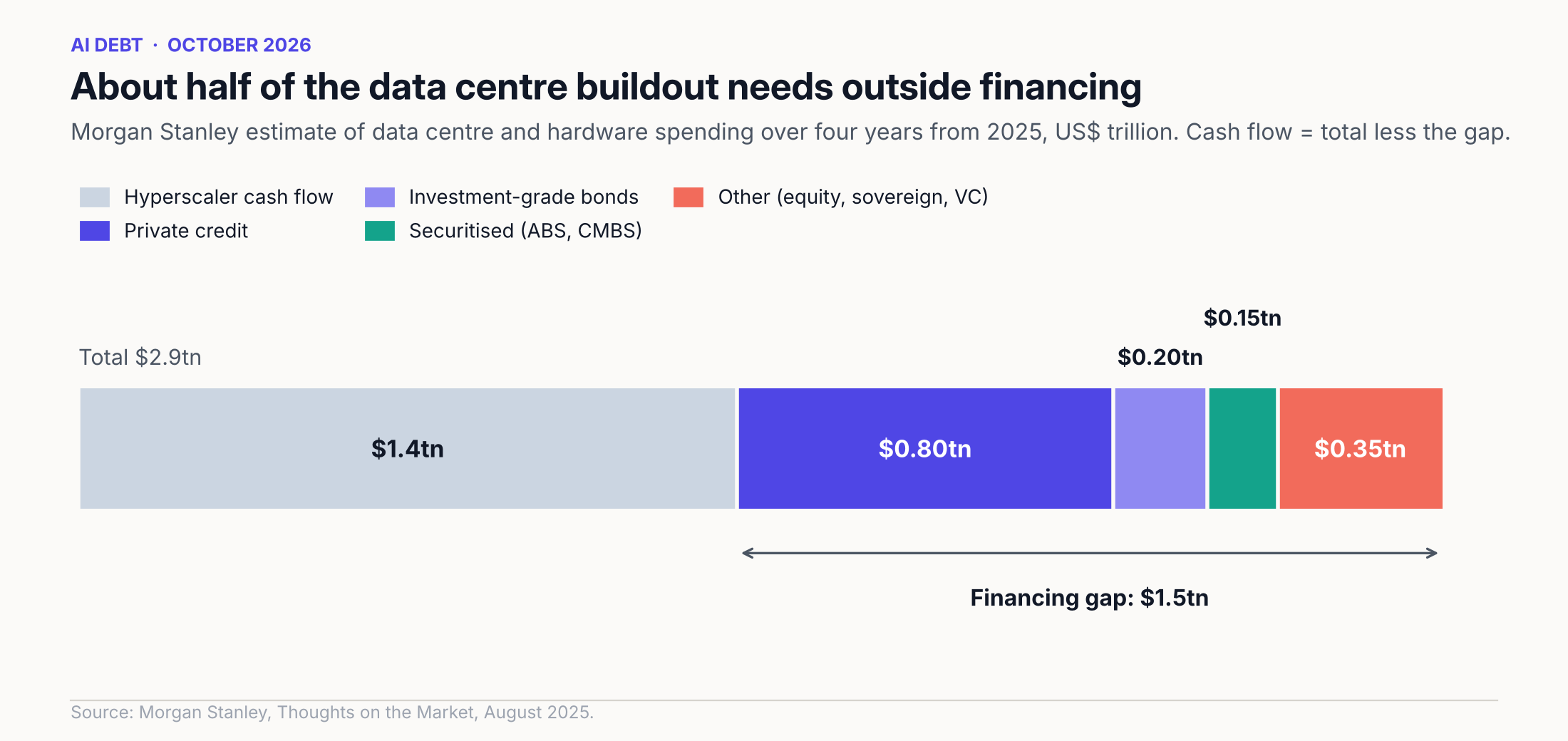
Morgan Stanley’s estimate from August 2025 shows the size of the external financing need. It expects about $2.9 trillion of data centre and hardware spending over the following four years. It puts the financing gap at about $1.5 trillion, which leaves about $1.4 trillion covered by hyperscaler cash flow. The gap has to be financed, and Morgan Stanley expects private credit to provide about $800 billion of it.
Where the debt sits
The debt is spread across five types of lender and structure.
Hyperscaler corporate bonds. Investment-grade bonds issued by Alphabet, Amazon, Meta, Microsoft and Oracle. Most of these companies have large cash balances. Wolf Street counts $775 billion of cash and marketable securities at ten AI-related companies, including $242.5 billion at Alphabet.
Project bonds issued by special-purpose vehicles. The largest is the $27.3 billion bond for Meta’s Hyperion data centre in Louisiana, issued in late 2025 with a 6.581% coupon and a 2049 maturity. Funds managed by Blue Owl own 80% of the project and Meta owns 20%. PIMCO bought $18 billion of the bond. The joint venture’s debt is not reported as Meta’s borrowing.
Bank construction loans. Lenders including JPMorgan and MUFG have been distributing about $38 billion of construction debt for an Oracle-leased data centre project in Texas and Wisconsin. A bank group lent about $18 billion for Project Jupiter, the Oracle-leased campus in New Mexico.
Private credit. The Bank of England estimates that private credit’s share of AI investment financing rose from 9% in 2024 to 34% in 2025.
Neocloud borrowing. Neoclouds are companies that rent GPU computing capacity to AI developers. CoreWeave, the largest, had $35.6 billion of debt and $16.3 billion of operating lease liabilities at the end of June. About 80% of its debt is secured on GPUs.
Off-balance-sheet commitments are larger than reported debt. A Nikkei Asia analysis reported in July found that the five companies had about $1.35 trillion of debt on their balance sheets. They also had about $1.65 trillion of off-balance-sheet commitments, mainly data centre leases that have not started and purchase commitments for GPUs and servers. Meta’s off-balance-sheet total was about $420 billion.
What has unwound so far
Equities
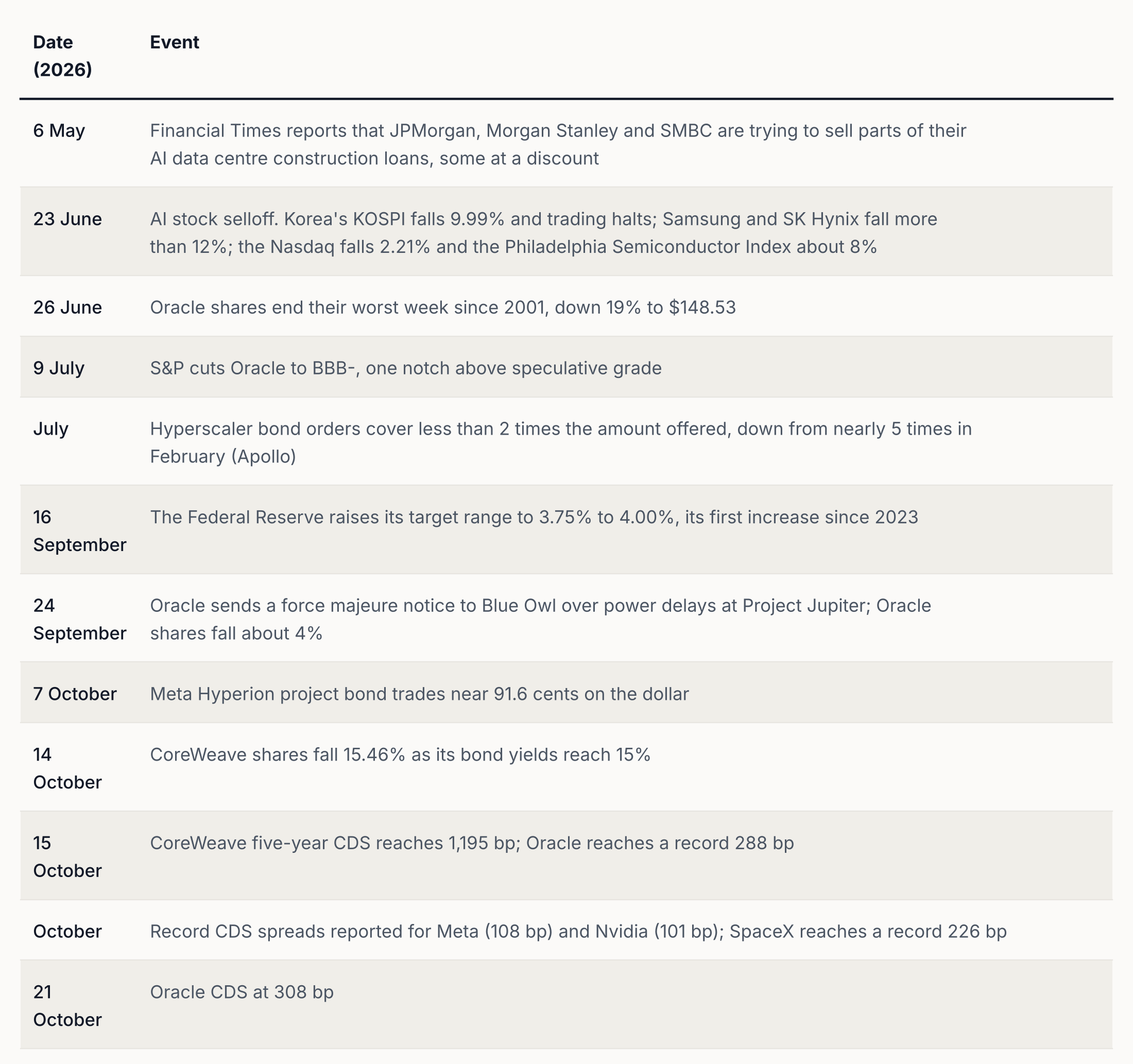
On 23 June the KOSPI fell 9.99%, led by memory chipmakers, and the Nasdaq fell 2.21%. Oracle fell 19% in the week to 26 June after its fiscal-year results showed negative free cash flow of $23.7 billion and capital spending of $55.7 billion. Its closing price of $148.53 was 57% below its 52-week high of $345.72.
CoreWeave shares fell about 38% in October to $54.24 on 23 October, 62% below their 52-week high of $141.79.
Credit
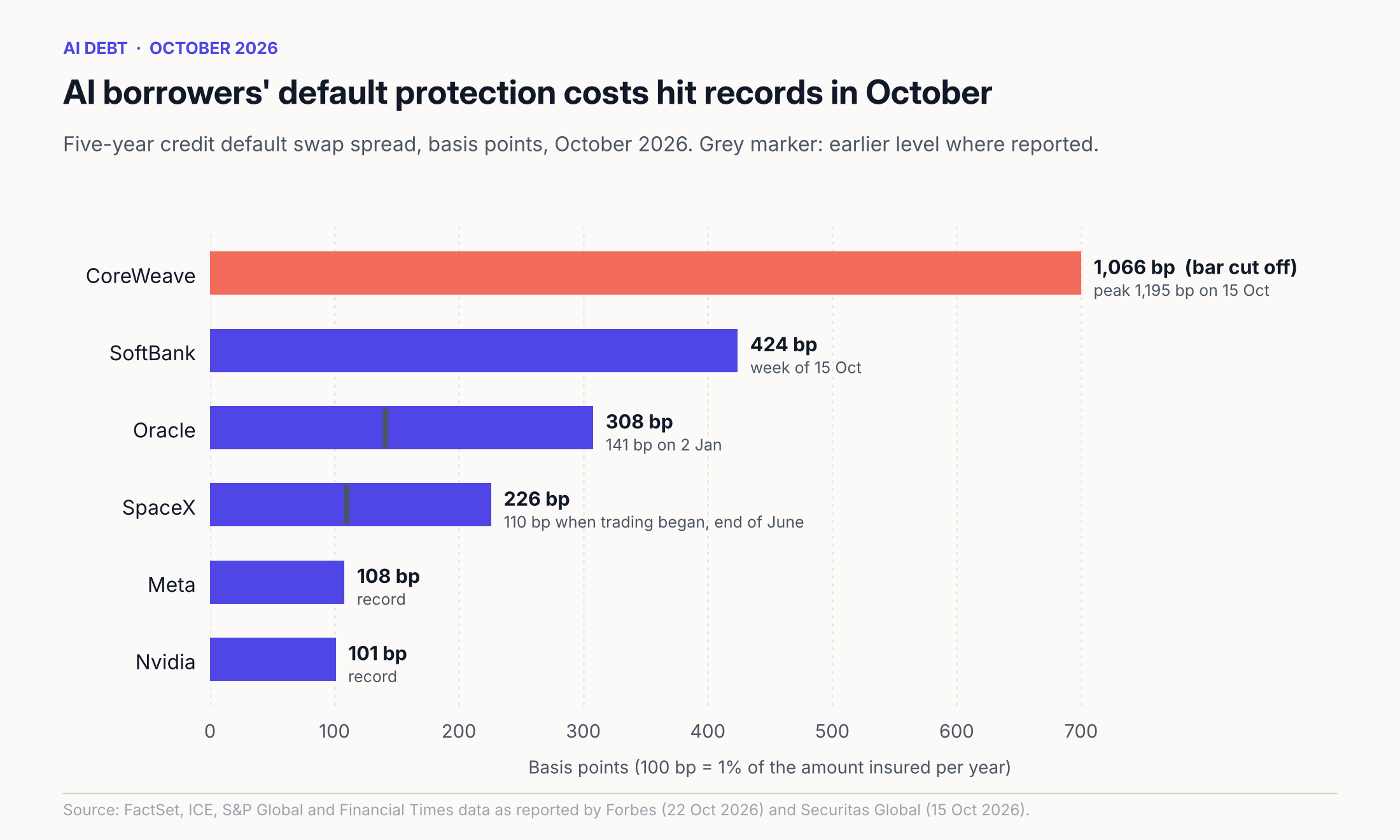
A CDS spread is the annual cost of insuring a company’s debt against default, as a percentage of the amount insured. 100 bp means 1% a year. Oracle’s spread more than doubled during 2026, from 141 bp to 308 bp. CoreWeave’s reached 1,195 bp at its peak, which priced a default probability above 60% over five years (Forbes). Spreads on Meta and Nvidia, which Deutsche Bank groups with AA-rated AI issuers, reached records but remain near 100 bp.
CoreWeave’s unsecured notes, issued in June at a 9.625% yield, traded below 80 cents on the dollar, a yield above 15%. The Hyperion project bond fell to about 91.6 cents.
As of 22 September, spreads on AI-related issuers were around 115 bp, against 78 bp for the broader investment-grade market (Goldman Sachs and ICE BofA data, reported by Reuters). Amazon paid an extra 18 to 21 bp on the longest bonds in its $25 billion July offering.
Oracle
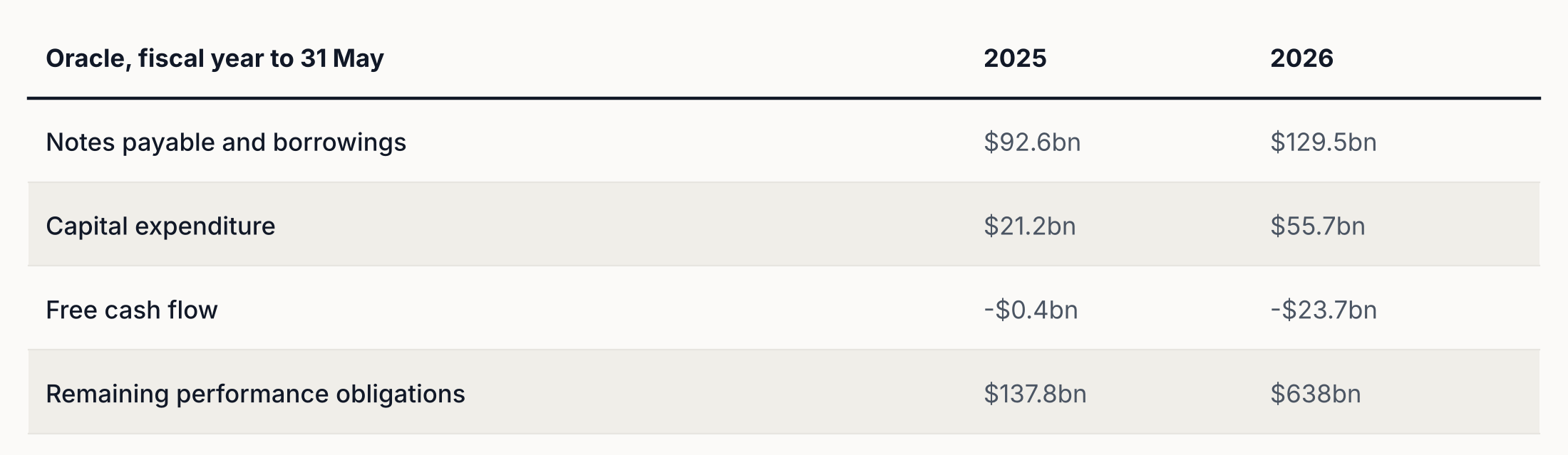
Oracle’s borrowings rose $36.9 billion in fiscal 2026 while its capital expenditure rose to $55.7 billion. Its remaining performance obligations, the value of contracted revenue not yet recognised, rose about 4.6 times. Securitas Global reports that roughly half of that backlog is tied to OpenAI. S&P forecasts a free operating cash flow deficit of about $42 billion in fiscal 2027.
Projects and banks
On 24 September Oracle sent a force majeure notice to Blue Owl, the developer of Project Jupiter, a 2.5 gigawatt campus in New Mexico. A force majeure clause excuses a party from obligations when events outside its control prevent performance. Gas pipeline approvals for the site were rejected in March and July. According to Reuters’ source, the notice lets Oracle keep paying the lower development-stage rent for longer if the campus misses its 2028 start. Oracle cannot terminate the lease, and Oracle says the project remains on schedule.
Banks have been reducing what they hold. The Financial Times reported in May that JPMorgan and MUFG had spent more than six months distributing the $38 billion of Oracle-linked construction debt. Banks are using syndication, direct loan sales and significant risk transfer trades, in which outside investors take on part of the credit risk of a loan portfolio.
How far it has spread
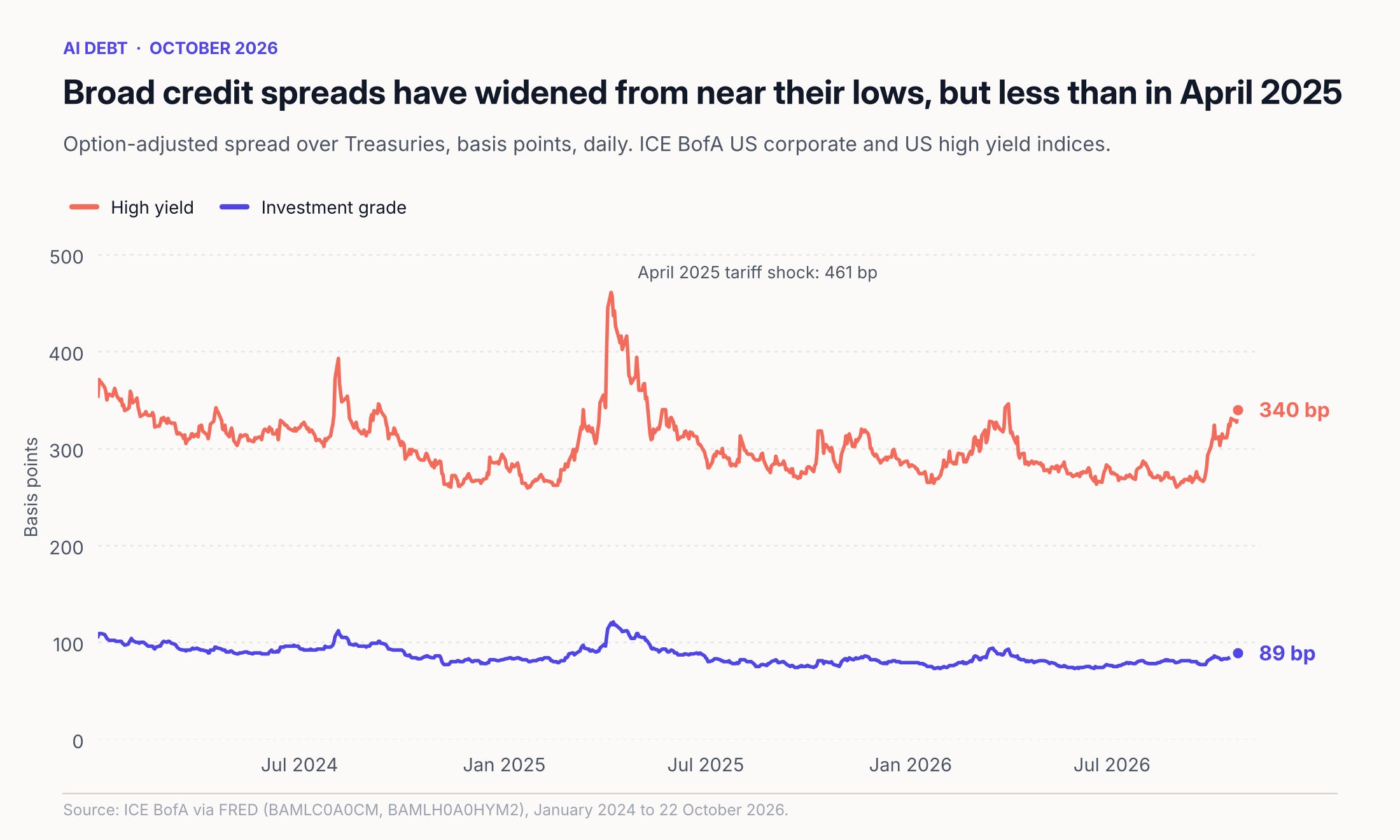
Broad credit spreads have moved less than AI borrowers’ spreads. The broad ICE BofA US corporate index spread was 89 bp on 22 October, 16 bp above its 2026 low. The US high yield spread was 340 bp, 80 bp above its 2026 low. Both are below their April 2025 peaks of 121 bp and 461 bp, and below their March 2026 highs of 94 bp and 346 bp.
The Federal Reserve raised its target range in September. Forbes describes most of CoreWeave’s debt as floating-rate private credit, so its interest cost rises with policy rates. Hyperscalers front-loaded their 2026 bond sales and, according to Wolf Street, have issued less since. Goldman Sachs still expects their issuance to reach $420 billion in 2027.
What has not unwound
The largest borrowers’ finances. Alphabet held $242.5 billion of cash and marketable securities at the end of June. Meta, Alphabet, Amazon and Microsoft still borrow at investment-grade spreads, and Vanguard described their credit quality as strong in August.
Defaults. None of the borrowers named here has defaulted. CoreWeave reports that 98% of its revenue comes from committed take-or-pay contracts, and it has $103.7 billion of contracted backlog.
Spending plans. Hyperscaler capital spending guidance for 2026 has not been cut in the sources reviewed here.
Where the risk is concentrated
One customer. About half of Oracle’s backlog is reported to be tied to OpenAI. CoreWeave’s three largest customers produced 72% of its second-quarter revenue.
Collateral value. About 80% of CoreWeave’s debt is secured on GPUs. Gartner estimated in October that more than $3.5 trillion of AI infrastructure spending could face impairment by 2030, and that more than 80% of neocloud providers could stop operating independently by then.
Maturity mismatch. The Hyperion bond matures in 2049, later than Meta’s leases on the site, and bondholders rely partly on Meta’s residual value guarantee (TokenPost).
Retail private credit. Some AI loans sit in non-traded business development companies and interval funds. Interval funds typically cap quarterly withdrawals at 5% of fund assets.
Indicators to watch
Oracle’s CDS spread and any further rating action.
CoreWeave’s bond prices and its next financing.
Order book coverage and new-issue concessions on hyperscaler bonds.
Trading prices of project bonds such as Hyperion.
Bank significant risk transfer deals referencing data centre loans.
The Federal Reserve’s decision at its 27 to 28 October meeting.
Notes on the figures
Debt totals differ by source because definitions differ. Vanguard’s issuance series counts bonds issued by five hyperscalers. Morgan Stanley’s forecast covers other AI-linked issuers and financing structures. Forbes does not define its $466 billion figure, and the same article also says AI-related issuance passed $500 billion.
CDS levels, bond prices and some events are as reported by the publications listed below, which cite FactSet, ICE, S&P Global, Bloomberg, Reuters and the Financial Times. Several of these primary sources could not be accessed directly.
Credit spreads in the broad spreads chart come from FRED and are daily.
Sources
Vanguard, “The AI buildout comes to the bond market”, 19 Aug 2026
Forbes, “Bond investors push back as AI debt heads toward $570 billion”, 17 Jul 2026
Forbes, “The half-trillion-dollar silicon gamble: inside the AI debt boom”, 22 Oct 2026
Reuters via Daily Caller, Goldman Sachs forecast of 2027 hyperscaler issuance, 22 Sep 2026
Reuters via Yahoo Finance, Oracle triggers force majeure on data center project, 24 Sep 2026
DatacenterDynamics, Oracle force majeure notice to Blue Owl, 24 Sep 2026
Financial Times via Resultsense, banks offload AI data-centre debt, 6 May 2026
American Banker, “How banks are navigating the AI data center backlash”, 31 Aug 2026
Oracle debt table, fiscal 2026 Form 10-K, via stock-analysis-on.net
Startup Fortune, AI neocloud stocks sink as CoreWeave debt fears spread, 25 Oct 2026
GuruFocus, Meta $27.3B AI data center bond drops, 7 Oct 2026
TokenPost, Hyperion project bond falls to record low near 91 cents, Oct 2026
Tech Startups, Nikkei Asia analysis of off-balance-sheet commitments, 23 Jul 2026
The jump in Oracle's five-year CDS from 141 bp to 308 bp this year shows how quickly the market is repricing the most leveraged AI borrowers. The Hyperion bond trading near 91.6 cents is a useful marker for off-balance-sheet financing.