


Anthropic sells frontier AI models to businesses, priced per token, and pays for the compute behind them with about $895 billion of commitments that run to 2045. This analysis works through the S-1 (26 October 2026) and the amended S-1/A (2 November 2026), which added third-quarter figures. It follows a business-model method: what the company sells, the unit economics, who captures the surplus, the moat, the reinvestment runway, the end state, accounting and governance.
Disclosure: drafted with Claude, which Anthropic makes. Figures come from the filings directly or as reported by the coverage linked in each section. No price range had been filed when this was written. This is analysis, not a recommendation.
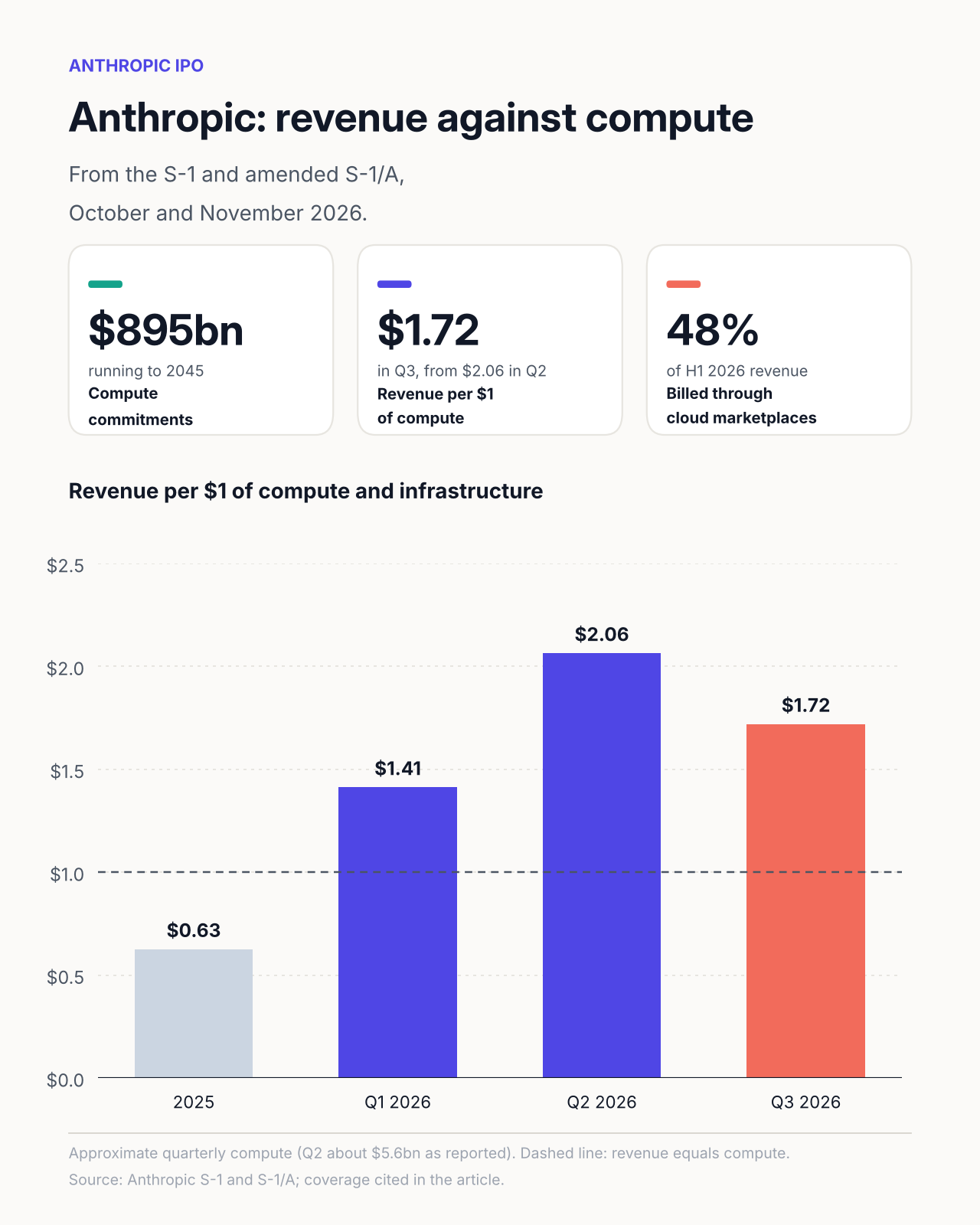
Summary:
Anthropic resells leased compute as model output. Consumption (pay per token) was 80% of first-half 2026 revenue; subscriptions were 20%.
Revenue per $1 of compute and infrastructure rose from $0.63 in 2025 to about $2.06 in Q2 2026, then fell to about $1.72 in Q3. In Q3, revenue grew 47% on Q2 and compute expense grew about 77.5%, and the company moved from a $974 million operating profit to a $567 million operating loss.
The reported 85% gross margin excludes training compute and free-tier inference. Revenue less all compute and infrastructure was 45% of first-half revenue.
48% of first-half revenue was billed through the AWS, Google Cloud and Azure marketplaces. The same three companies supply compute, and Amazon and Google are shareholders.
Compute commitments total $895.4 billion: $69.8 billion falls due within 12 months, against $131.9 billion of cash and short-term investments at 30 September. Remaining performance obligations, the contracted revenue not yet recognised, were $13.8 billion, about 2.4 months of Q3 revenue.
Control sits with a founder share (50.1% of general votes) and a trust that elects four of seven directors. Class A holders’ votes are capped at 49.9%.
The case rests on one question: can revenue per dollar of compute grow faster than the price of model output falls, before the contracted compute arrives?
Terms
Compute and infrastructure: the cost of the chips, data centres and cloud capacity used to train and run the models. In the S-1 it is split across cost of revenue, research and development, and sales and marketing.
Gross margin: revenue less cost of revenue, as a share of revenue. What goes into cost of revenue is a company choice.
Remaining performance obligations (RPO): revenue under signed contracts that has not yet been recognised.
Net revenue retention (NRR): revenue in a period from customers who were customers a year earlier, as a share of their revenue a year earlier. Definitions differ between companies.
Run-rate revenue: a recent period’s revenue scaled to a year. The S-1 defines it as trailing 28-day consumption fees times 13 plus monthly subscription fees times 12.
Commitment: a contract to buy compute or lease equipment in future, mostly non-cancellable, recorded off the balance sheet until the lease starts.
1. What the business sells
Anthropic’s revenue comes from selling model output. Consumption was $13.1 billion and subscriptions $3.2 billion of first-half 2026 revenue (Mostly Metrics). More than 11,900 customers spent over $100,000 in the 12 months to 30 September, up from more than 950 a year earlier (S-1).
The main input, compute, is supplied by cloud providers and chip partners through leases and purchase commitments rather than bought with Anthropic’s own capital. That makes the business closer to a capacity operator, with contracted capacity and falling unit prices, than to a software company.
2. Revenue and unit economics
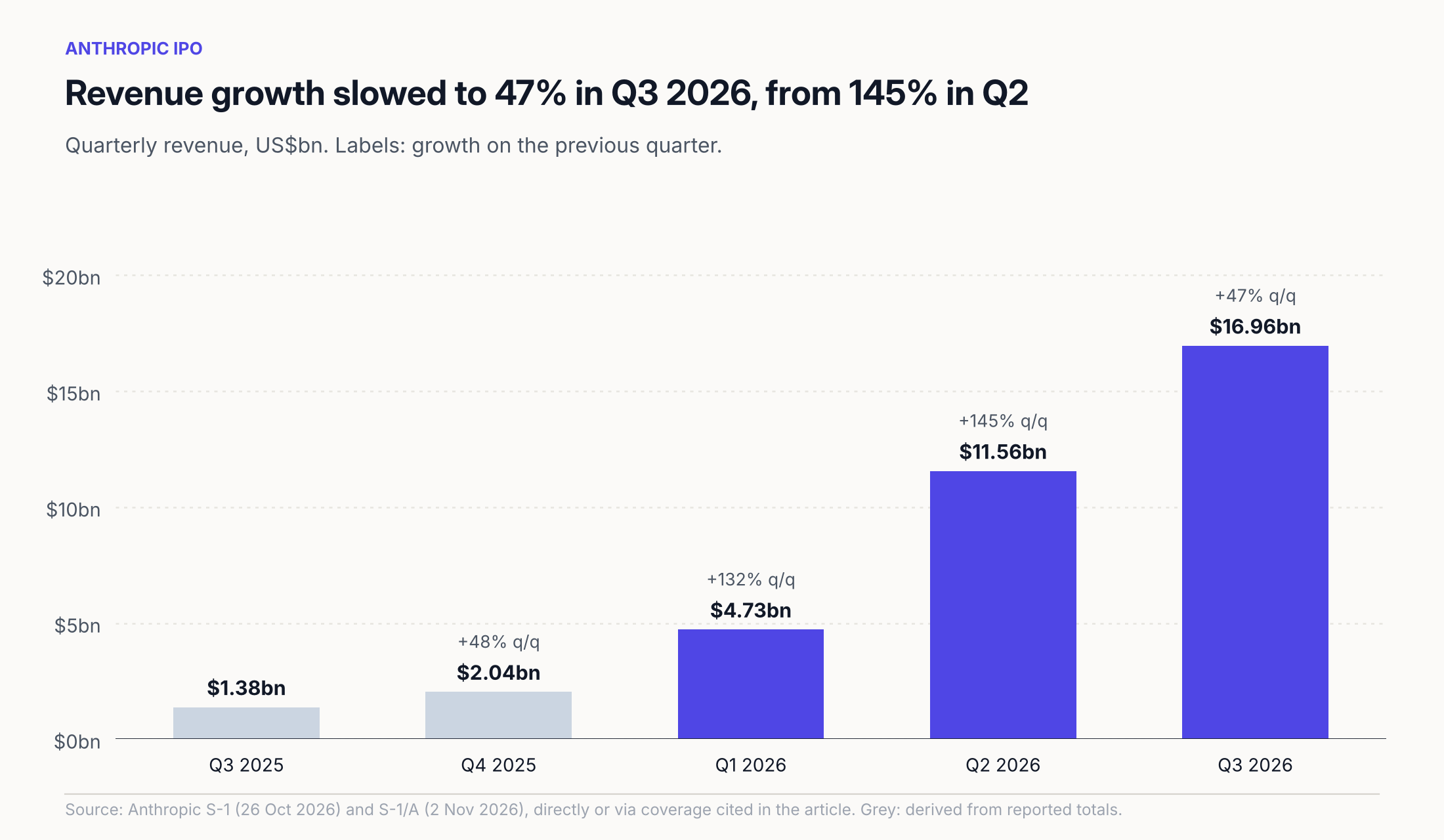
Quarterly revenue grew 132% in Q1 2026, about 145% in Q2 and 47% in Q3, to $16.96 billion. The Q3 and Q4 2025 figures are derived from reported annual, half-year and growth figures.
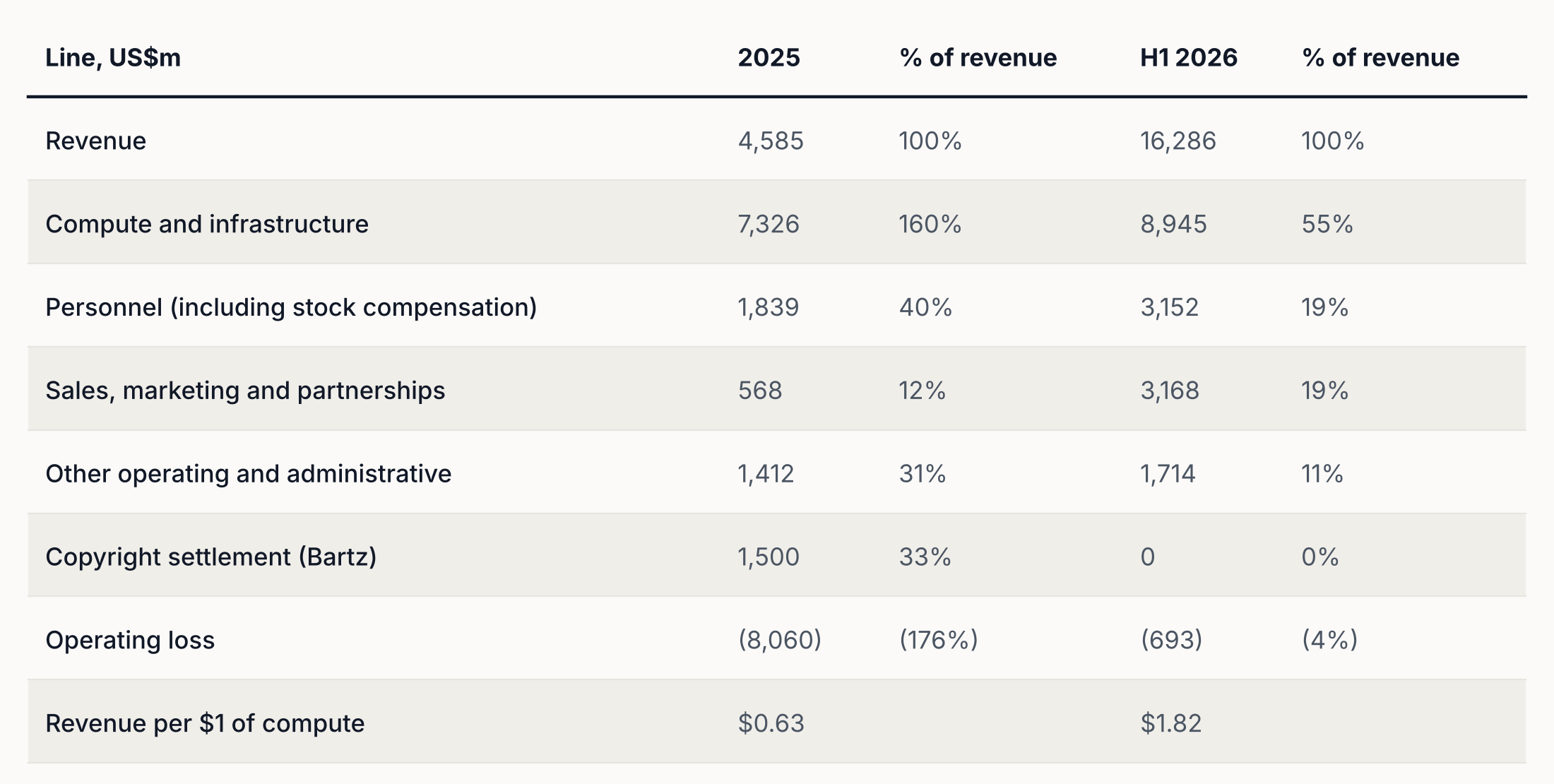
Source: S-1 summary financial data. Percentages and revenue per $1 of compute are calculated here.
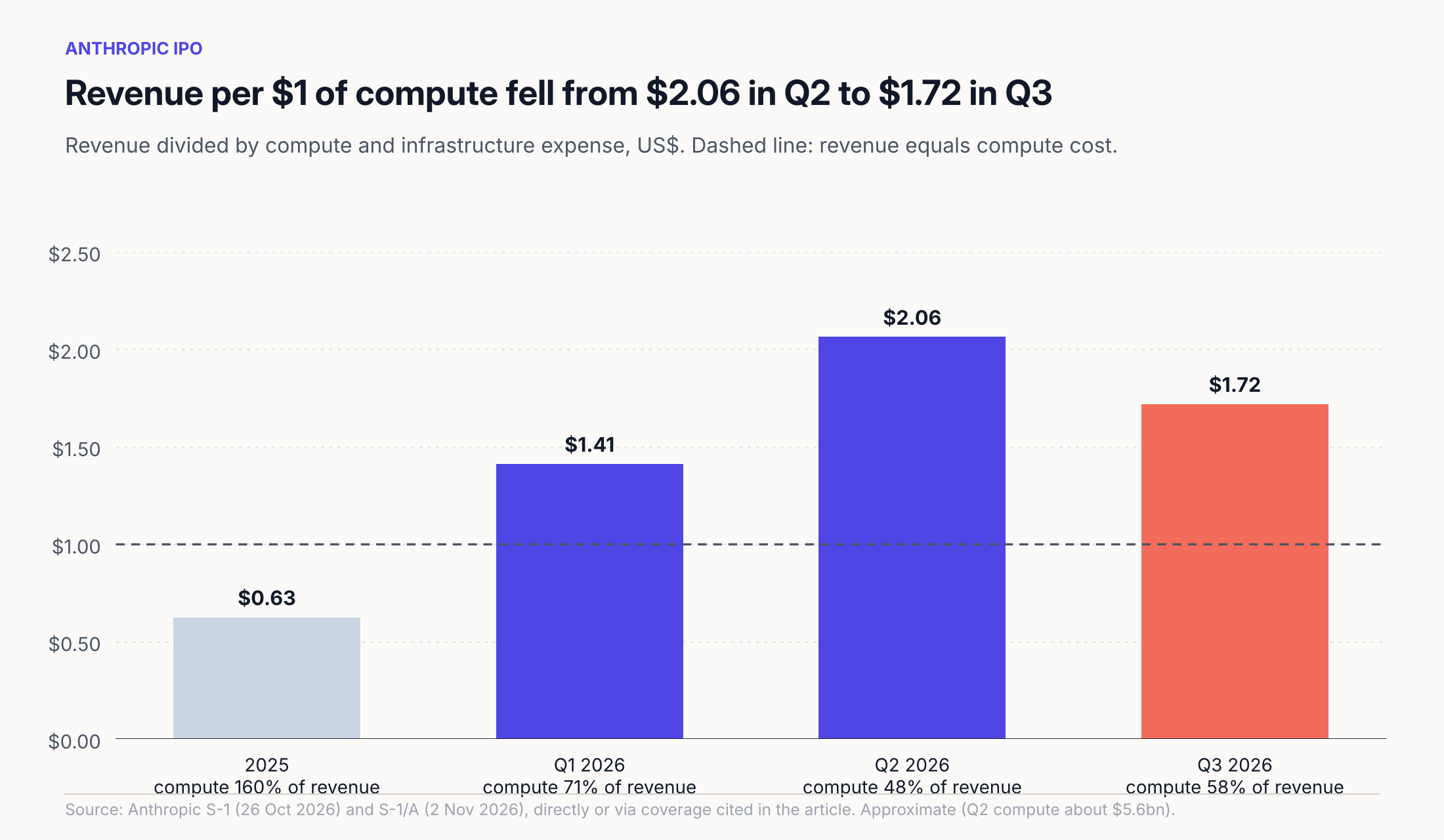
Revenue per $1 of compute is revenue divided by compute and infrastructure expense. It measures how much revenue each dollar of compute produces. On approximate quarterly figures it was $1.41 in Q1, $2.06 in Q2 and $1.72 in Q3. Q2 compute is about $5.6 billion (MarketMusings) and Q3 compute $9.86 billion (Securities.io, BeInCrypto).
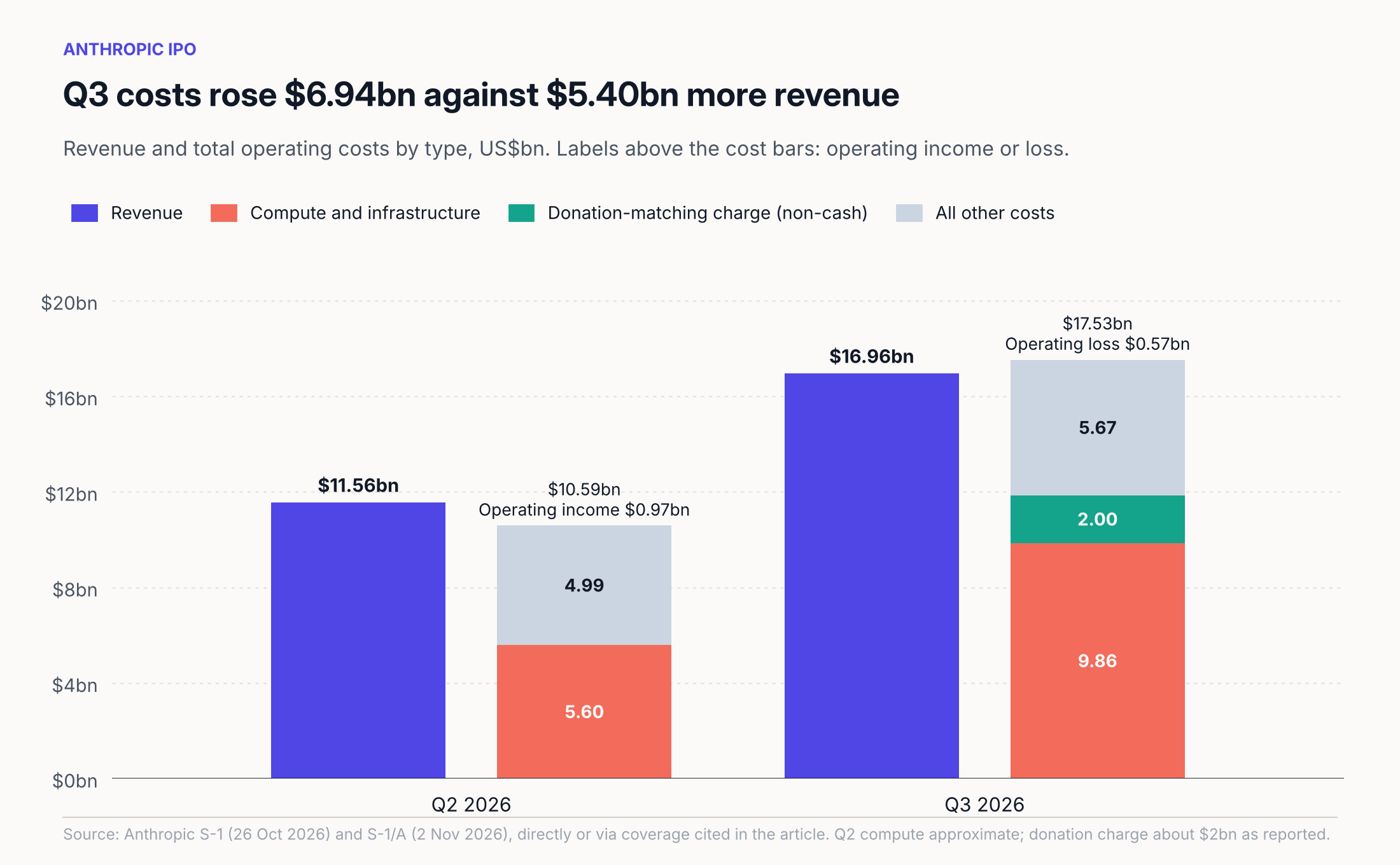
Between Q2 and Q3, revenue rose $5.40 billion and operating expenses rose $6.94 billion (BeInCrypto). About $4.26 billion of the increase was compute. The company said short-term compute bought to meet demand cost significantly more than multi-year capacity (Yahoo Finance). Adjusted operating margin, which excludes stock compensation and donation charges, fell from 19% to 15%.
Operating cash flow was $6.57 billion for the nine months to 30 September. After $925 million of capital expenditure, free cash flow was about $5.6 billion; after $1.96 billion of lease prepayments as well, about $3.7 billion (PPC Land).
Conventional return on invested capital is not a useful measure here. Most of the $141.1 billion raised to 30 June sits as cash and short-term investments, and the productive asset, leased compute, reaches the balance sheet only when a lease starts. $451.2 billion of signed leases had not yet started (Securities.io).
3. Who captures the surplus
Compute and infrastructure plus sales, marketing and partnerships, which holds the cloud channel fees, took about 74% of first-half revenue.
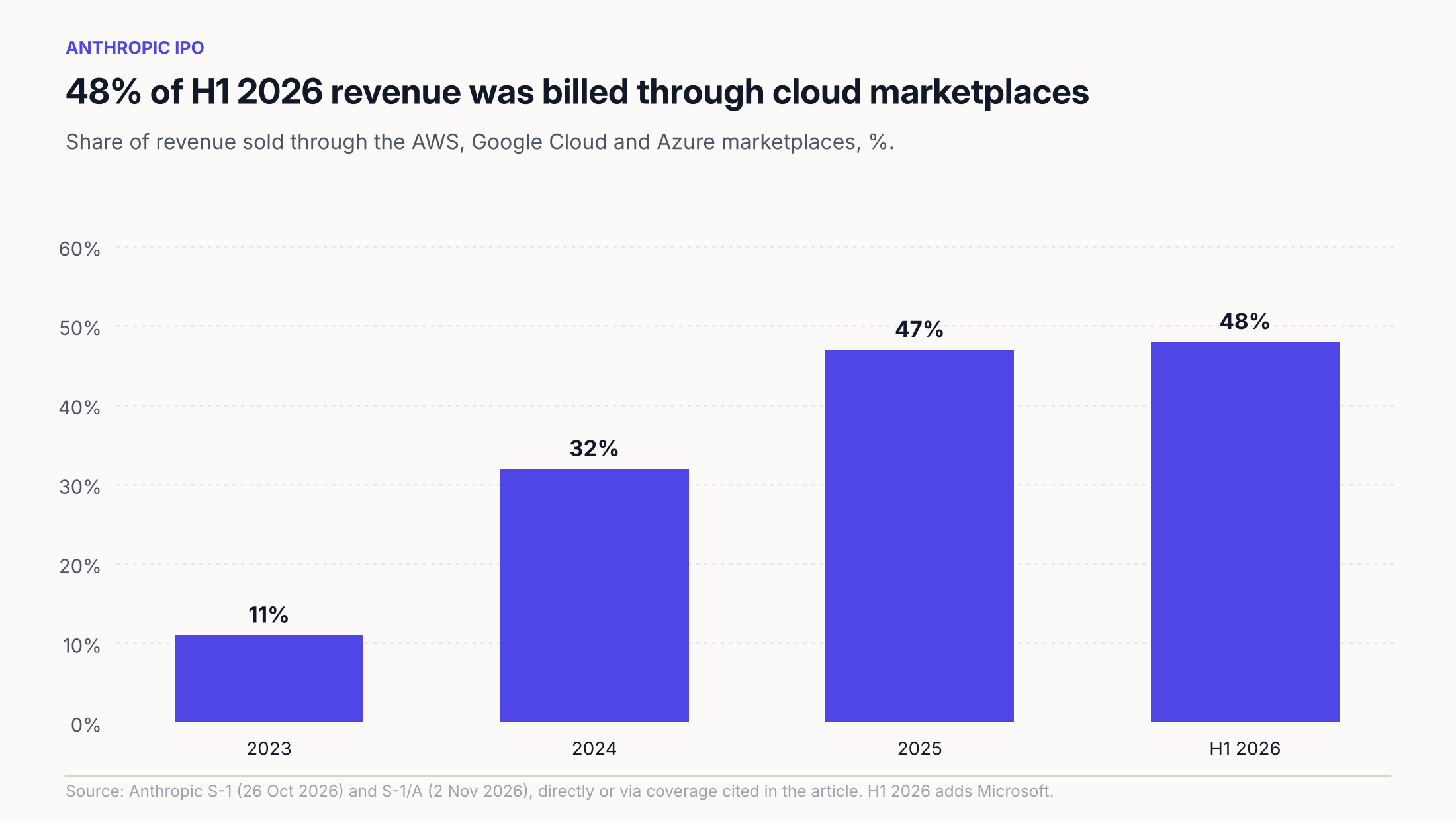
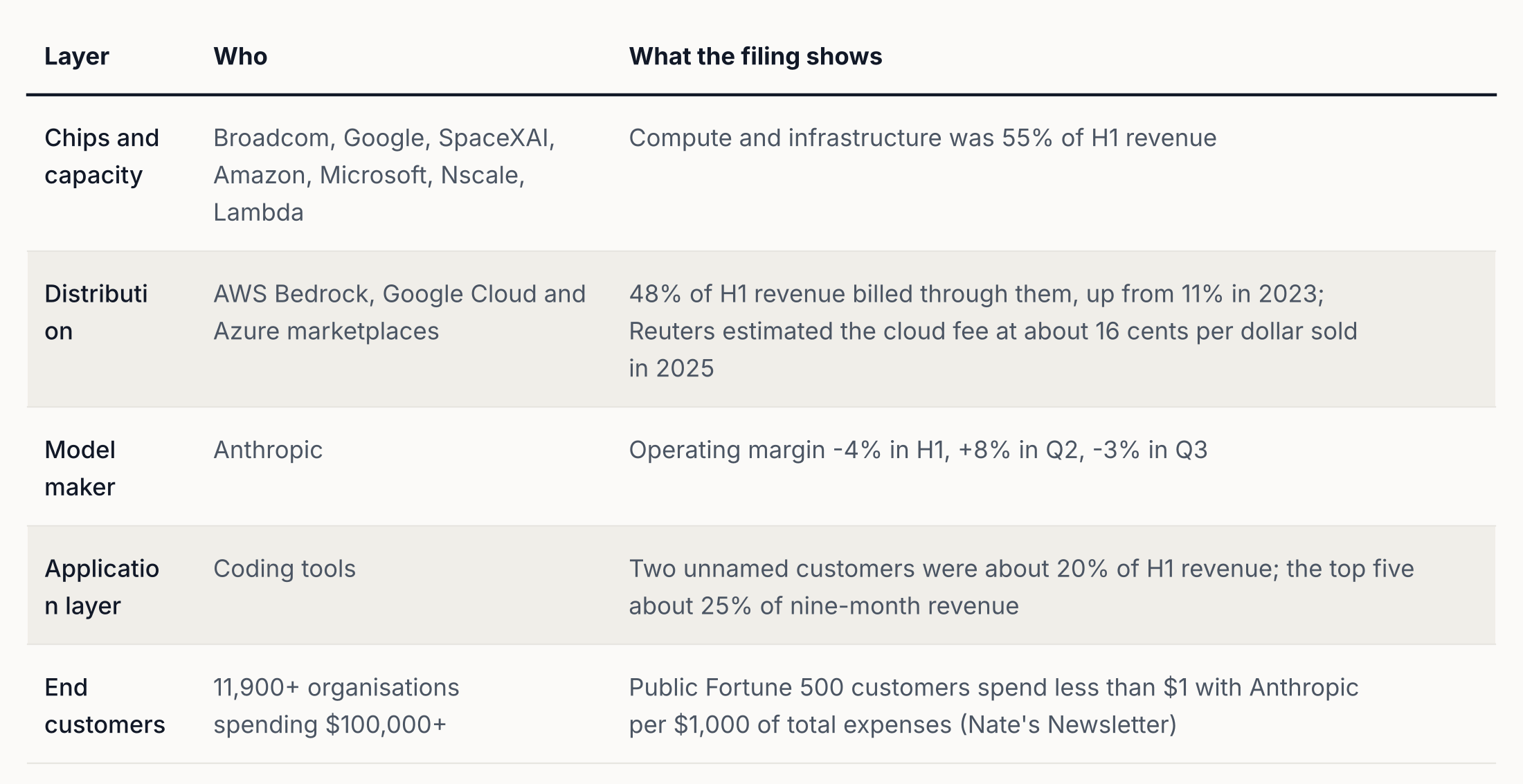
The S-1 says the cloud providers can see Anthropic’s pricing and commercial terms and could favour their own models. They supply compute, bill nearly half of revenue, take a fee on it, and Amazon and Google will each hold more than 5% of the stock in non-voting Class N shares (FourWeekMBA). The cloud partners also declined to supply all the compute Anthropic asked for (VKTR). SpaceX’s AI unit, which holds up to $120.5 billion of the compute contracts and runs its own model, acquired Cursor, a coding tool built on models including Claude (Yahoo Finance).
Operating leverage, where costs grow more slowly than revenue, shows in personnel (40% of revenue in 2025, 19% in H1 2026) but not yet in compute.
4. Public ratios and how others respond
The S-1 made four outlying figures public. Each gives another party a reason to ask for more:
85% gross margin: cloud providers can push compute prices and marketplace fees up at renewal; competitors can see room to undercut. Price cuts and discounts already reduced Q3 revenue by about $600 million (Yahoo Finance).
About 900% net revenue retention: customers’ Anthropic bills grew about ninefold in a year, which invites budget caps and routing of routine work to cheaper models. Open-weight models handled 29% of one gateway’s tokens in June for under 4% of spend (TechRepublic).
$6.6 million revenue per employee: a target for rival hiring. $24.1 billion of unrecognised stock compensation vests over about two years (Bret Kerr).
$895 billion of commitments: suppliers know Anthropic must buy, and rivals know how much capacity it will hold.
5. The moat
The lead is a capability lead that has to be earned again with each model generation, backed by access to compute and by workflow embedding.
Capability: Anthropic held about 40% of enterprise model API spend, against 27% for OpenAI and 21% for Google, in a Menlo Ventures survey (Forbes). The best open-weight models are estimated to trail by about four months (CompanionLink).
Workflow embedding: more than half of $100,000+ customers use both the API platform and a first-party app such as Claude Code or Cowork, up from about 30% at the end of 2025 (TechCrunch).
Compute access: a multi-chip fleet (Trainium, TPU, NVIDIA, AMD). This is an advantage while capacity is scarce and a fixed cost if it is not.
Distribution: all three major clouds, which also compete with it.
At the frontier, the cost of entry is very high: research and development was $9.7 billion in H1 2026 (mlq.ai). For routine work, open-weight models lower the buyer’s cost close to zero: on one gateway they ran 71.5% of September tokens for 23% of spend (RockCyber Musings). Each model generation lowers the price of a task; the S-1 says Opus 5.5 cut customer cost per task by about 40% against Opus 5.
In March 2026 the US Department of Defense designated Anthropic a supply-chain risk after talks broke down over limits on mass surveillance and autonomous weapons. Anthropic sued; its lawyers said the action put hundreds of millions to billions of dollars of 2026 revenue at risk (The Hill).
6. The commitments
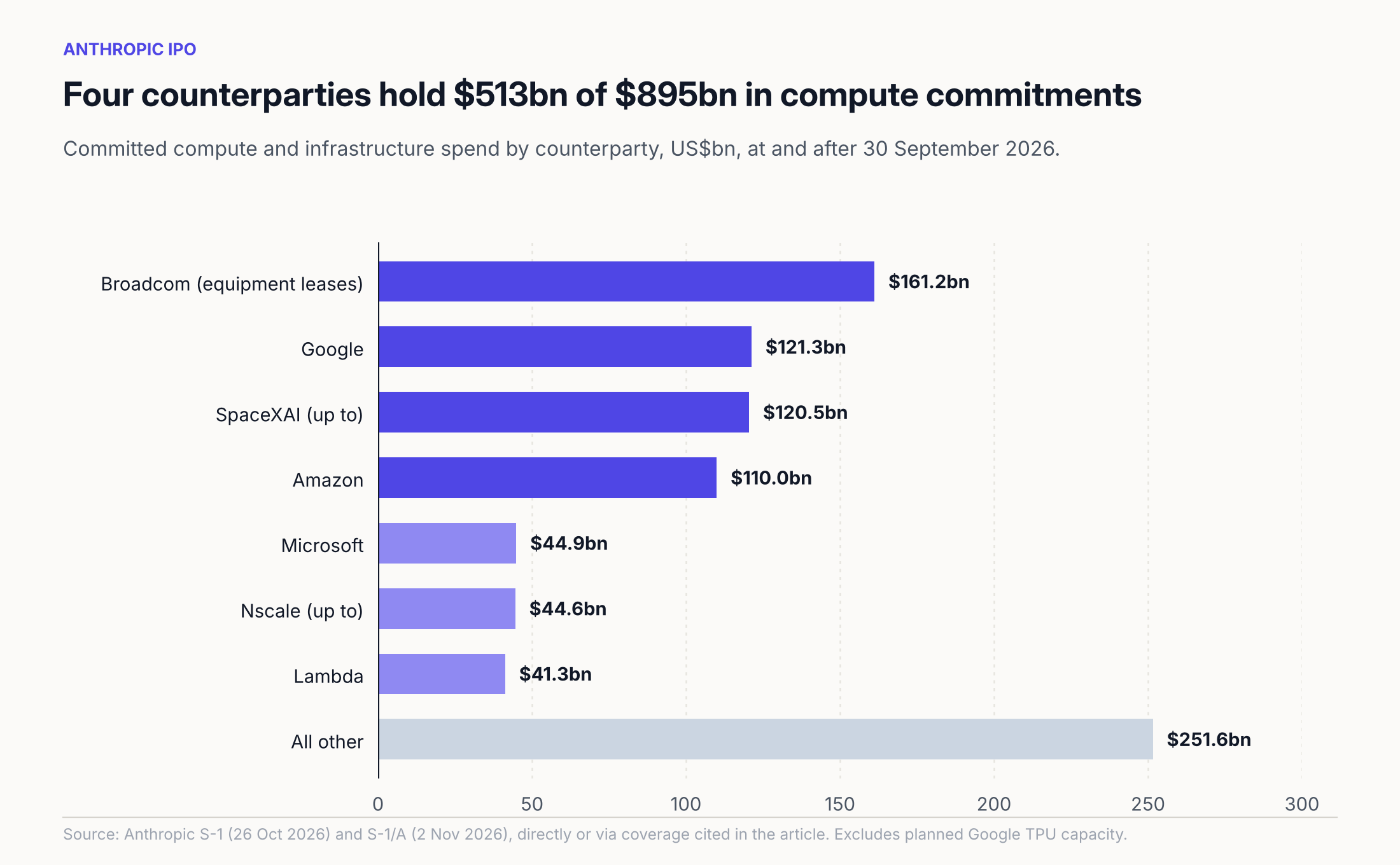
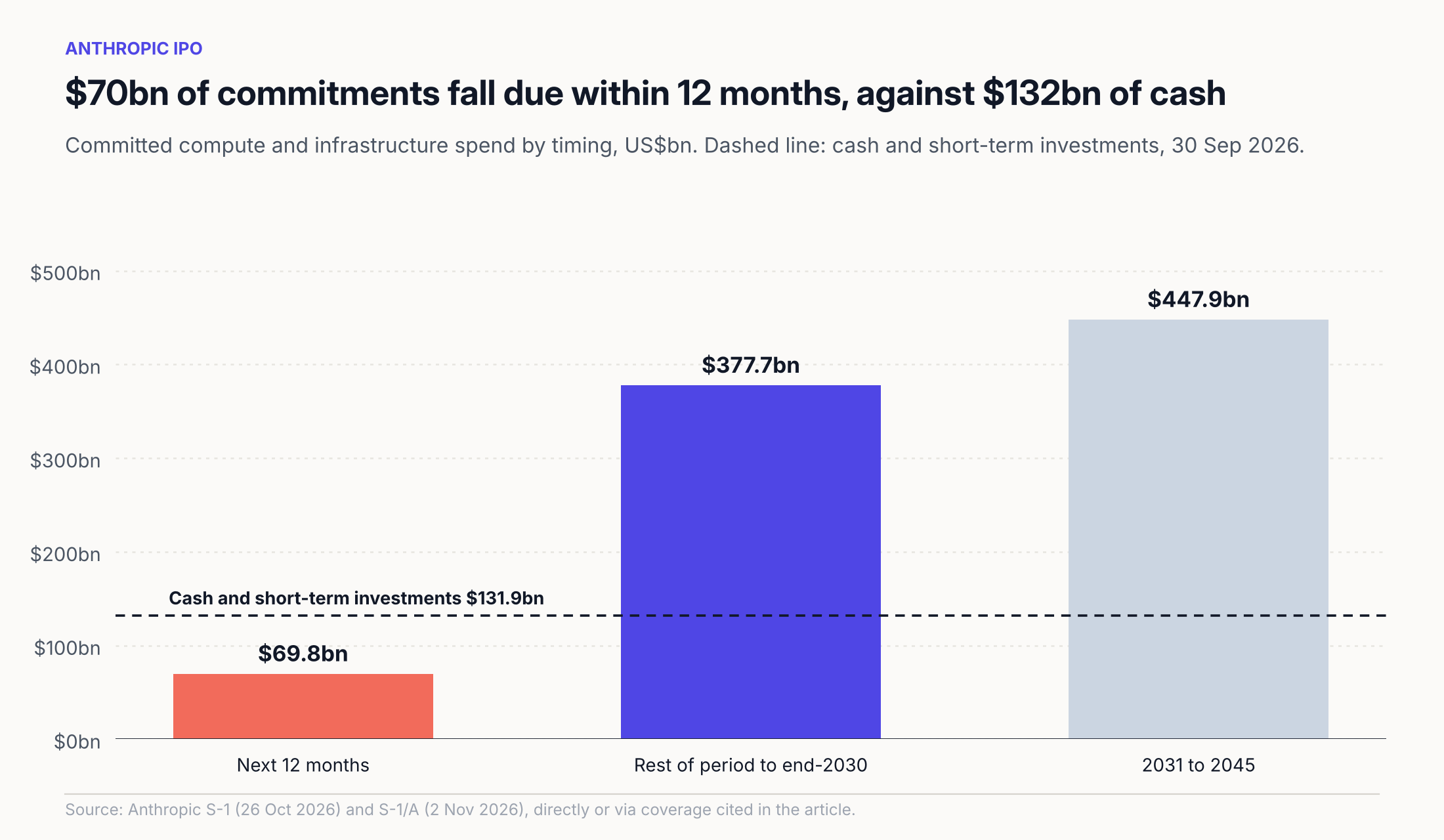
Four counterparties (Broadcom, Google, SpaceXAI and Amazon) account for $513 billion of the $895.4 billion. $69.8 billion is due within 12 months and $447.5 billion by the end of 2030; the rest falls between 2031 and 2045 (mlq.ai). Another $125 billion to $150 billion of planned Google TPU capacity for 2028 to 2031 is not in the total (DCD).
The SpaceXAI contract is about $3.1 billion a month at full delivery, expected from December 2026 (Securities.io), or about $37 billion a year. Q3 compute expense annualised was about $39 billion. Cash and short-term investments of $131.9 billion cover the next 12 months of commitments about 1.9 times.
Compute is bought 12 to 18 months before delivery and expensed when it arrives (Yahoo Finance). The Google and Amazon contracts cannot be cancelled except for the counterparty’s uncured breach and include true-up payments if spending falls short (Unite.AI). The SpaceXAI contract has cancellation rights (FourWeekMBA).
7. The end state
A mature software company is often valued like a bond: high cash generation and little reinvestment. Anthropic’s filing points to a different end state, closer to a capacity business such as an airline or a chip foundry, where capacity is fixed and profit depends on volume growing faster than prices fall.
The product loses value quickly: price cuts cost about $600 million of Q3 revenue, and each new model generation cuts cost per task.
Reinvestment continues at maturity: research and development was $9.7 billion in H1 2026.
Revenue is contracted for weeks and costs for decades: RPO of $13.8 billion is about 2.4 months of Q3 revenue, against commitments about 65 times larger.
Large investors were reported to see $1.5 trillion to $1.6 trillion as a fair valuation (Dataconomy), against $965 billion at the May 2026 Series H. Q3 revenue annualised is about $67.8 billion, so $1.5 trillion is about 22 times that and $2 trillion about 29 times. As an illustration only: at 25 times earnings and a 25% net margin, a $1.5 trillion valuation needs about $240 billion of revenue, about 3.5 times the Q3 run-rate, at a margin the company has not yet reported in any quarter.
8. Accounting and definitions
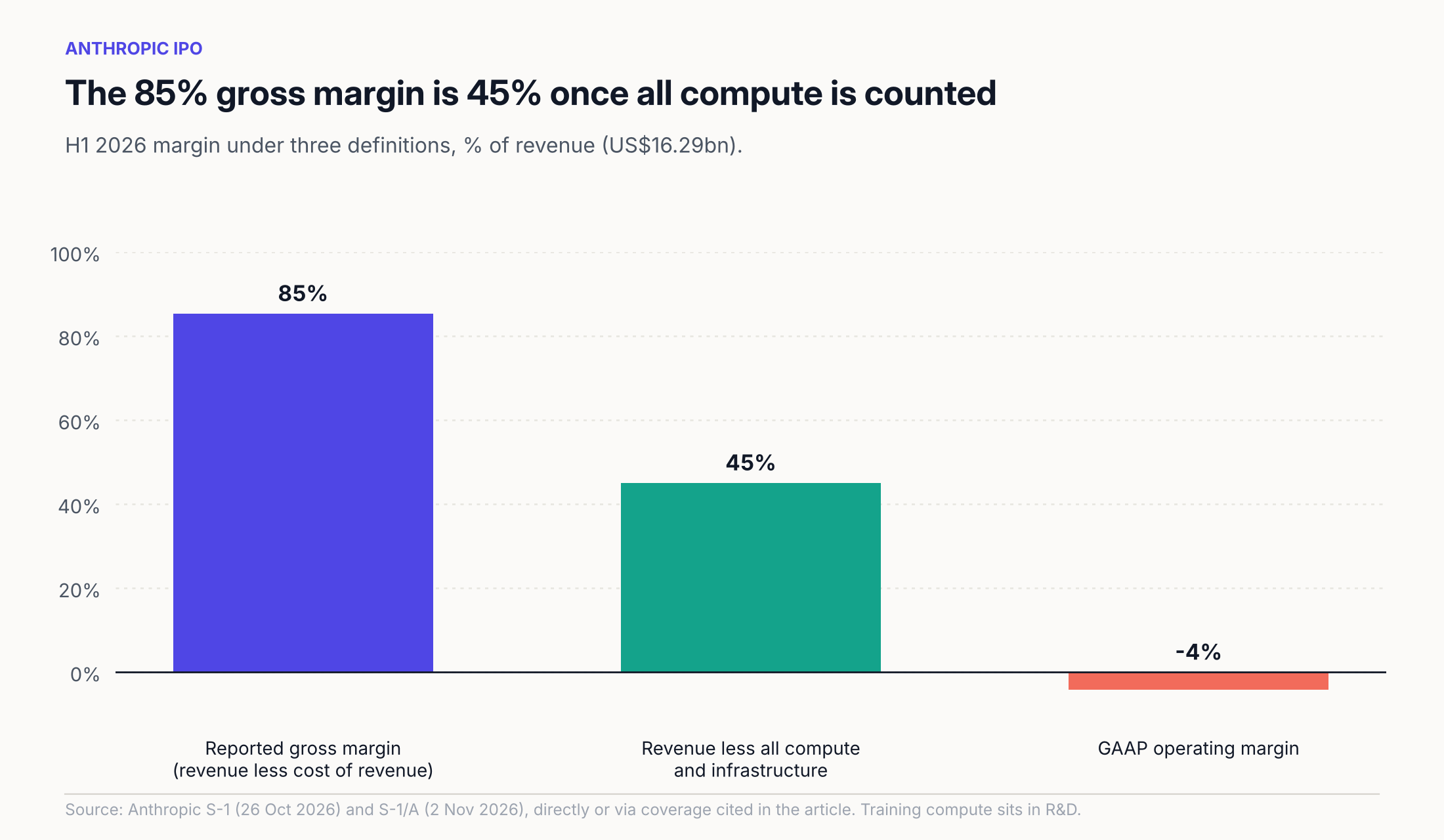
Gross margin is a functional allocation. Cost of revenue was $2.38 billion in H1 against $8.95 billion of total compute and infrastructure. Training sits in research and development; free-tier inference and cloud channel fees sit in sales, marketing and partnerships (Les Barclays, mlq.ai). Revenue less all compute was about 45% in H1 and about 42% in Q3.
Marketplace sales are booked gross. The clouds are treated as collection agents and their fee as an operating expense. One estimate puts channel fees at about 17% of H1 revenue (The SaaS CFO), so revenue is not directly comparable with companies that book net.
Net revenue retention of about 900% is not the usual software measure. It compares the latest quarter with the same quarter a year earlier, counts any customer with at least $1 of revenue in the base quarter, and excludes Pro and Max subscribers (Kepler, S-1).
The net loss is mostly non-cash. The nine-month net loss was $104 billion, of which $94.3 billion was fair-value remeasurement of convertible notes and derivatives; the operating loss was $1.26 billion (Bret Kerr). Adjusted operating income excludes $3.3 billion of stock compensation and $2.1 billion of non-cash charitable contributions over nine months.
Dilution. Besides $24.1 billion of unrecognised stock compensation, the Anthropic Public Benefit Fund received 5% of fully diluted shares, and the board may issue up to a further 2% each time the share price rises 50% above the previous milestone (S-1).
A source conflict. One report gives nine-month compute expense as $14.4 billion (DCD); H1 ($8.95 billion) plus Q3 ($9.86 billion) gives about $18.8 billion. The quarterly compute ratios here use the second.
9. Governance and incentives
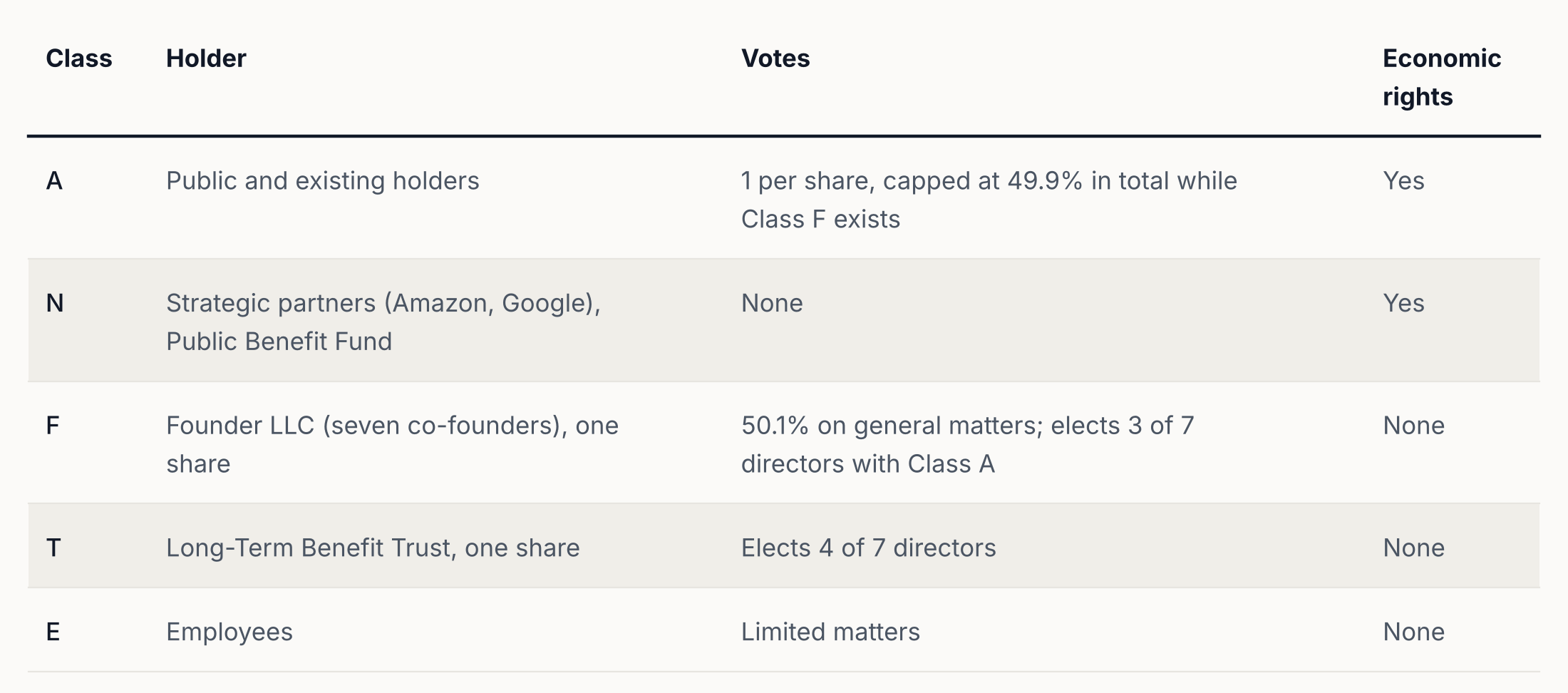
Sources: S-1, Neoteo.
Dario Amodei’s 2025 pay was $17.96 million, with no large performance grant (Crypto Briefing, Equilar). The performance condition on the 2026 executive and co-founder share grants is the registration statement becoming effective: they vest on listing, not on revenue, margin or shareholder return. The co-founders have pledged 80% of their equity to charity; the S-1 calls the pledges revocable and says donations reduce their economic interest without reducing their voting control (KuCoin).
Lock-ups release in stages: employees and non-founder directors may sell 10% of locked-up shares on the first day and another 35% after the FY2026 results, co-founders 29% at day 180, with about 23 release dates in the first year (Leverage Shares).
10. The single question and what to watch
Can Anthropic grow revenue per dollar of compute faster than the price of model output falls, before its contracted compute arrives? If it can, the fixed compute bill turns into operating leverage. If it cannot, Q3 is the pattern: revenue up 47%, compute up about 77.5%, and an operating loss.
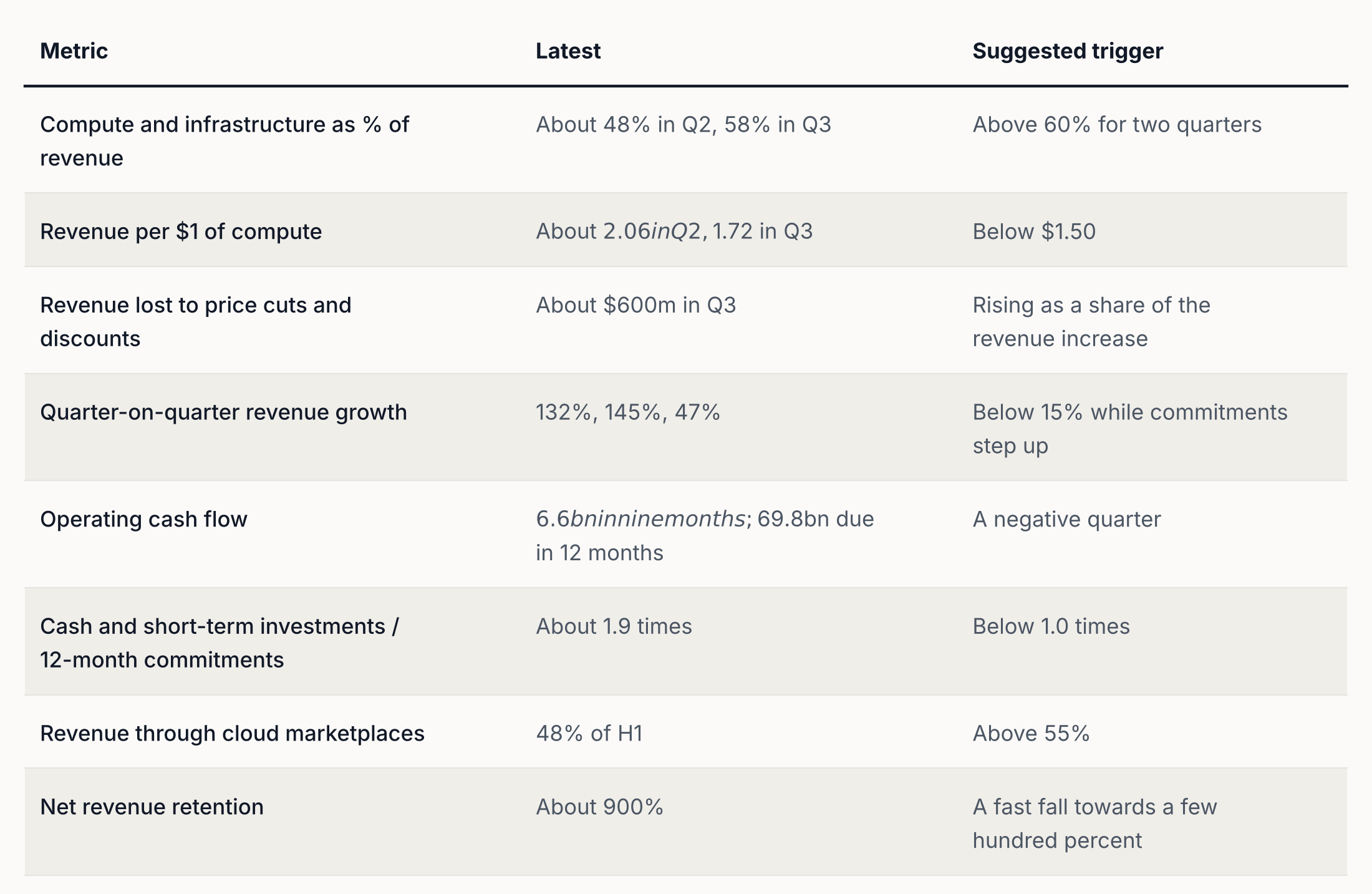
The triggers below are suggested thresholds, not company guidance.
Limitations
Approximate quarterly compute. Q2 compute (about $5.6 billion) comes from secondary coverage, and sources conflict on nine-month compute. Revenue per $1 of compute and the Q2 to Q3 bridge are approximate.
Derived quarters. Q3 and Q4 2025 revenue are derived from reported totals and growth rates. Q2 growth is 145% on these figures; some coverage reports 144%.
Secondary sources. Many figures are taken from coverage of the filings rather than the filing tables. Check the S-1/A before relying on any single number.
Valuation. The $1.5 trillion to $1.6 trillion range is a press report of investor views, not a filed price range. The revenue-needed calculation uses assumed multiples and margins.
Sources
Primary - Anthropic, PBC Form S-1, 26 October 2026 (SEC EDGAR)
Amended S-1/A coverage (2 November 2026) - Yahoo Finance: growth slowed and costs jumped in Q3 - Quartz: revenue up about 1,200% through September - BeInCrypto: amended filing in 5 numbers - Securities.io: $895.4bn of commitments - DCD: $895.4bn of cloud and data-centre commitments - Unite.AI: commitment terms - mlq.ai: revised S-1, $17bn quarter - PPC Land: Q3 operating loss and cash flow - FourWeekMBA: 12 new numbers in the S-1/A - Bret Kerr: The Bridge Toll
Original S-1 coverage - Yahoo Finance: gross margin 85% from 12% - mlq.ai: model development vs customer workloads - MarketMusings: S-1 first impressions - Les Barclays: notes on the S-1 - Mostly Metrics: S-1 breakdown - Kepler: S-1 breakdown and NRR definition - Nate’s Newsletter: customer growth and spend share - TechCrunch: cross-product adoption - Investing.com: 48% of revenue through cloud marketplaces - Calcalist (Reuters): cloud distribution fees - The SaaS CFO: gross vs net revenue - VKTR: compute squeeze from partners - Yahoo Finance: two customers 20% of H1 revenue
Governance, pay and lock-ups - FourWeekMBA: who owns Anthropic - Neoteo: founder votes and board elections - KuCoin: share structure and pledges - Crypto Briefing: CEO compensation - Equilar: a deeper look inside the S-1 - Leverage Shares: lock-up schedule
Competition, valuation and politics - Dataconomy: investors cut valuation target to $1.5 trillion - Forbes: enterprise API spend shares - TechRepublic: open-weight pressure - RockCyber Musings: open-weight token share - CompanionLink: open-weight lag - The Hill: Pentagon supply-chain risk designation
Not financial advice