

Anthropic, PBC filed a Form S-1 registration statement with the US Securities and Exchange Commission on 26 October 2026. It plans an initial public offering of Class A common stock on the Nasdaq Global Select Market under the ticker ANT. The filing does not yet include a price range or the number of shares offered. Goldman Sachs and Morgan Stanley are listed first among the underwriters, and Fortune reports a targeted listing in the week of Thanksgiving.
Disclosure: this analysis was prepared with Claude, a model made by Anthropic. Figures are taken from the filing and the sources listed at the end, and were checked by a separate review against the filing.
Summary
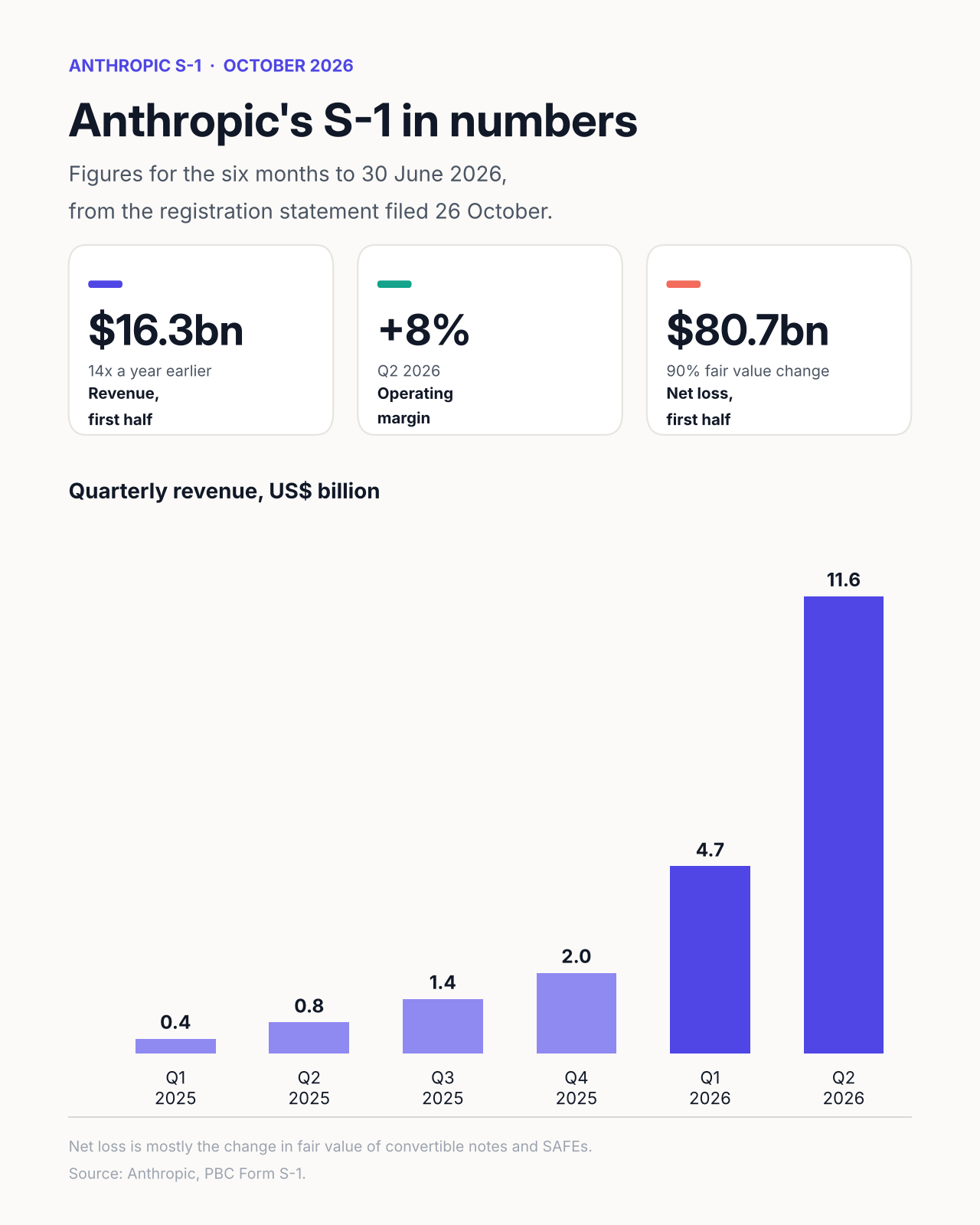
Revenue was $16.3 billion in the six months to 30 June 2026, against $1.2 billion a year earlier. Revenue in 2025 was $4.6 billion.
Second-quarter 2026 revenue of $11.6 billion was about twice compute and infrastructure expense of $5.6 billion, and the operating margin was 8%. For the first half the operating margin was minus 4%.
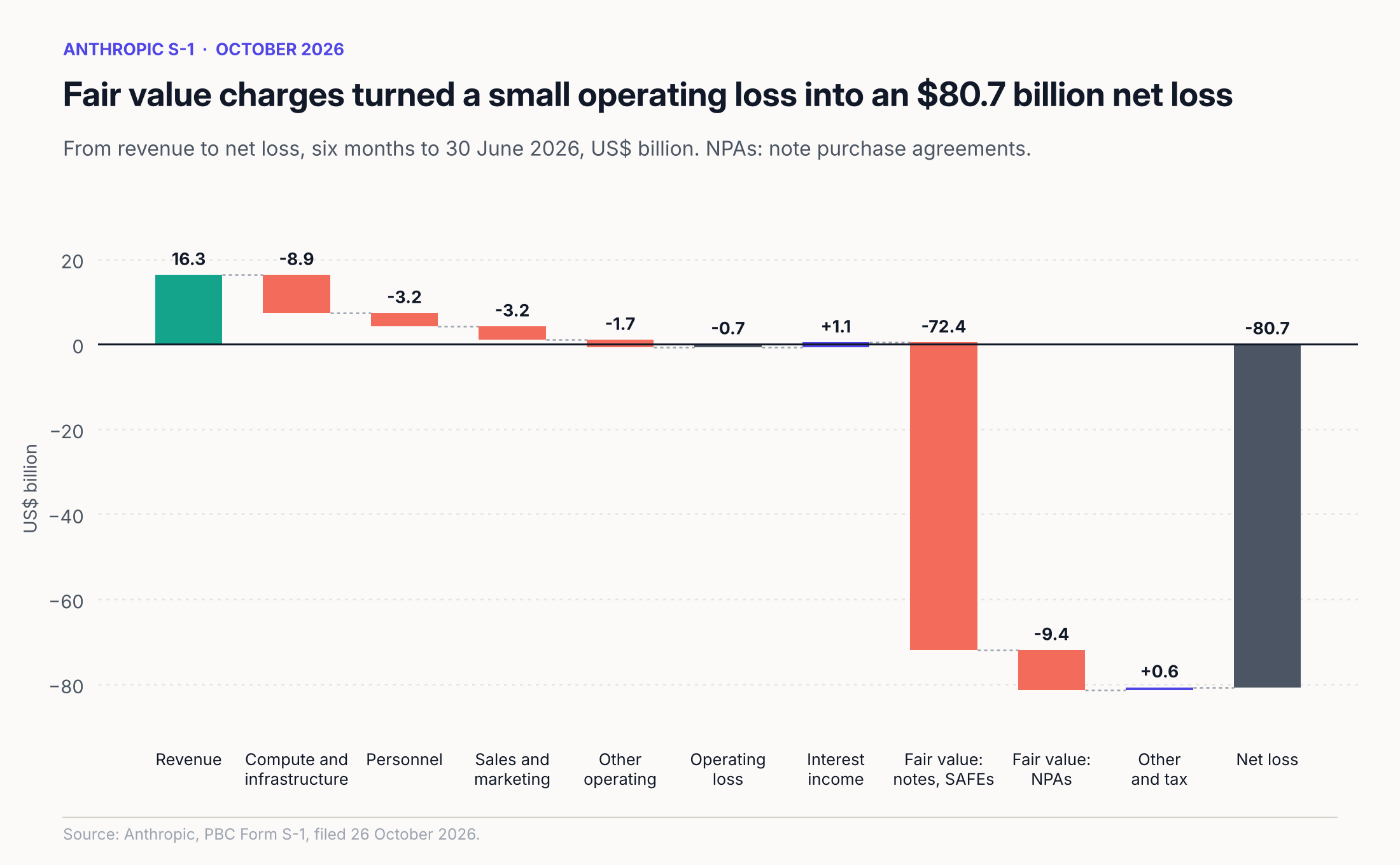
The first-half net loss was $80.7 billion. Fair value charges on convertible notes, SAFEs and note purchase agreements totalled $81.8 billion. These are non-cash, but they reflect value passing to investors whose instruments convert into shares.
The filing names compute and infrastructure commitments of at least $110.0 billion with Amazon, $114.5 billion with Google and $44.9 billion with Microsoft. It also lists up to $120.5 billion with SpaceXAI and about $161.2 billion of rent on Broadcom equipment leases.
An IPO would trigger a $2.9 billion stock-based compensation charge for restricted stock units, with a further $23.7 billion to be expensed over about 2.1 years.
In September a federal appeals court upheld, 2-1, the Department of War’s designation of Anthropic as a supply-chain risk. Anthropic has asked for a rehearing.
Voting control stays with the founders and a trust. Founder LLC, held by the seven co-founders, has 50.1% of the votes, and the Long-Term Benefit Trust elects a majority of the board.
Terms used
S-1: the registration statement a company files with the SEC before selling shares to the public. Price, share count and some figures are added in later amendments.
Public benefit corporation (PBC): a company whose directors must balance shareholders’ financial interests with a stated public benefit. Anthropic’s stated purpose is “the responsible development and maintenance of advanced AI for the long-term benefit of humanity”.
Convertible note: a loan that converts into shares, usually at a fixed price. A SAFE (simple agreement for future equity) is a similar instrument with no interest or maturity. A note purchase agreement (NPA) commits an investor to buy notes in future. All three are carried at fair value, so when the company’s valuation rises the liability rises and the increase is recorded as an expense.
Net Revenue Retention (NRR): in the filing, revenue in the latest three months from customers who had at least $1 of revenue in the same three months a year earlier, divided by their revenue in that earlier period. It excludes Claude Pro and Max subscribers.
Stock-based compensation (SBC): employee pay in shares or share units, recorded as an expense but not paid in cash.
Revenue
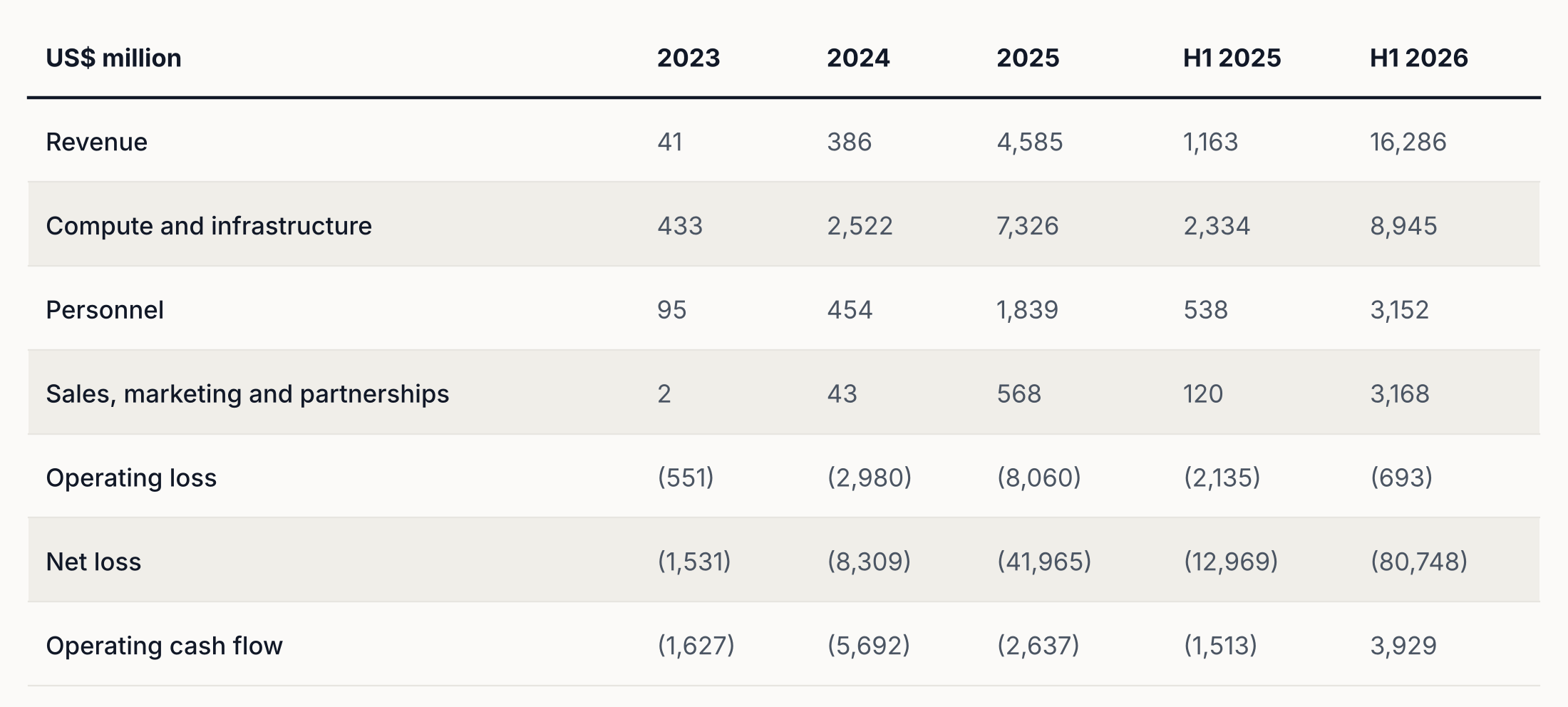
Revenue grew about 12 times in 2025, and first-half 2026 revenue was 14 times the first half of 2025. Second-quarter revenue rose 1,368% from a year earlier, while compute and infrastructure expense rose 300%.
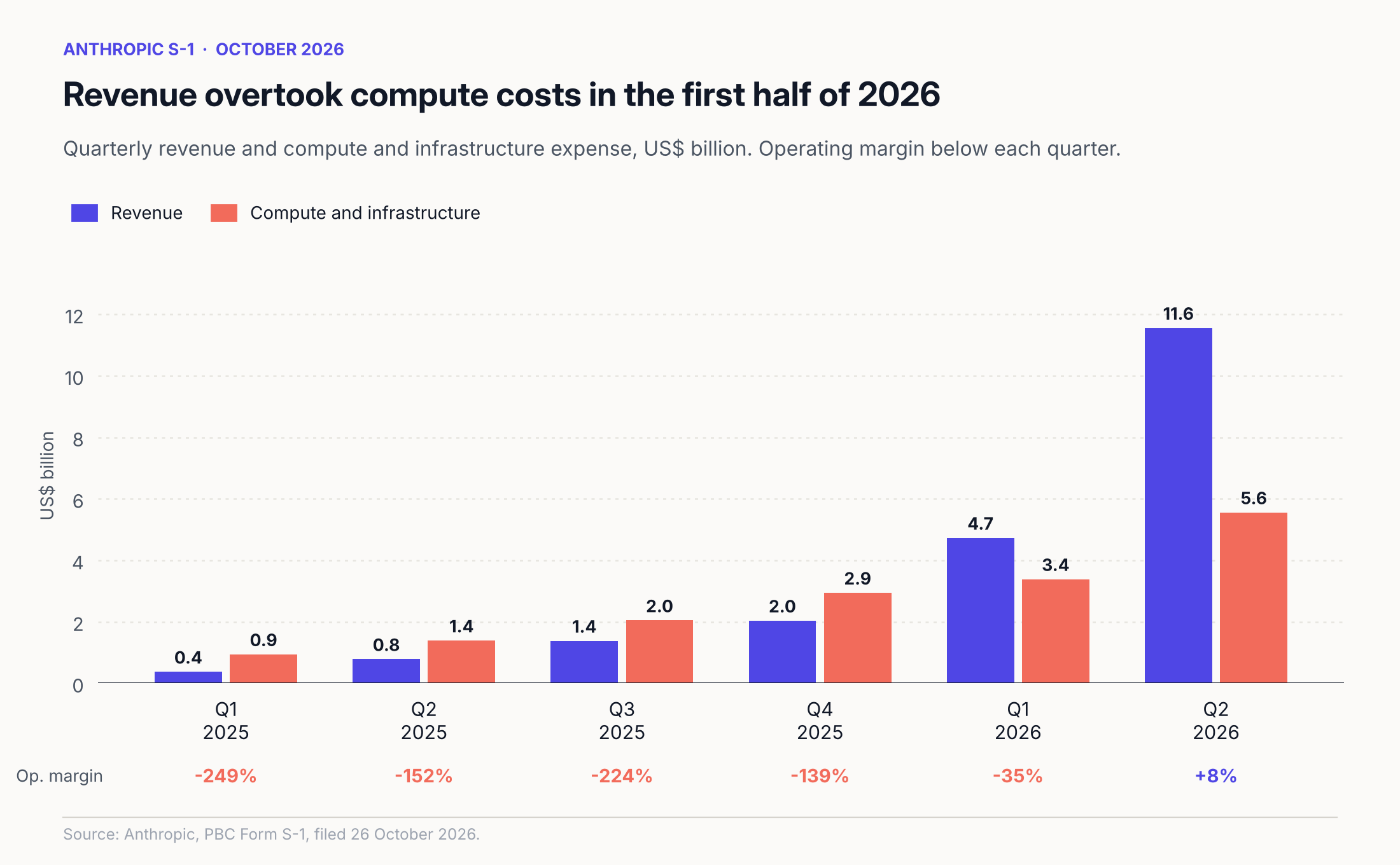
Revenue rose from $2.0 billion in the fourth quarter of 2025 to $4.7 billion in the first quarter of 2026 and $11.6 billion in the second. Compute and infrastructure expense, which covers training and running models, fell from 144% of revenue in the fourth quarter of 2025 to 48% in the second quarter of 2026. Revenue per dollar of compute expense rose from $0.57 in the second quarter of 2025 to $2.08. The positive margin is for one quarter.
Revenue comes in two forms:
Consumption-based: customers pay for usage. This was 75% of revenue in 2024, 83% in 2025 and 80% ($13.1 billion) in the first half of 2026.
Subscription-based: recurring fixed fees. This was 25%, 17% and 20% ($3.2 billion) over the same periods.
Customer figures as of 30 September 2026:
More than 11,900 customers paid $100,000 or more over the trailing 12 months, up from more than 950 a year earlier.
More than 1,900 paid $1 million or more, and about 250 paid $10 million or more.
Net Revenue Retention was about 900%.
Trailing 12-month revenue per employee was over $6.6 million, against $1.4 million a year earlier. The company had about 5,300 employees. The filing reports revenue only to 30 June, so this figure includes third-quarter revenue that has not been disclosed.
Losses and cash flow
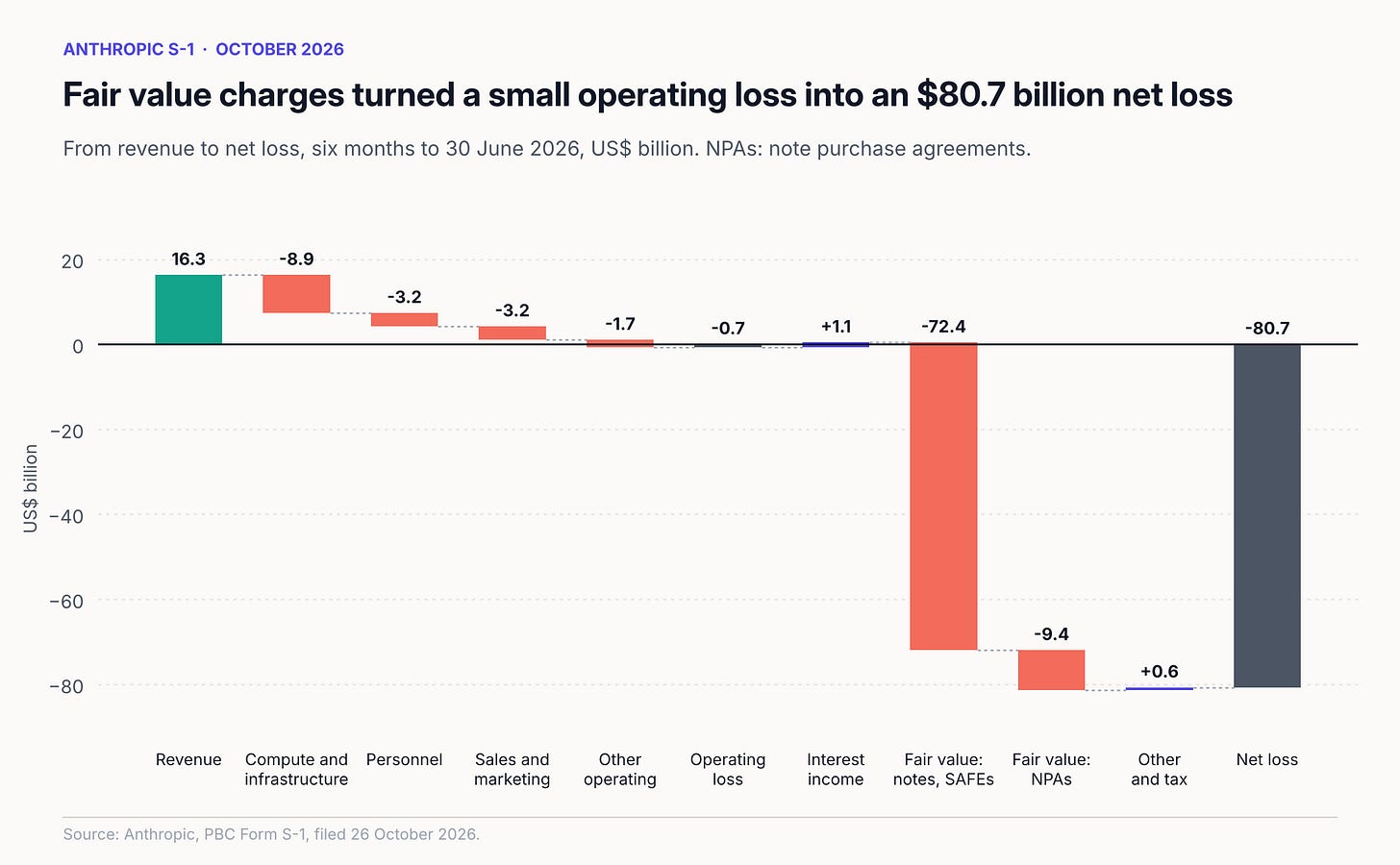
Most of the net loss comes from fair value accounting on financing instruments. Anthropic raised money through convertible notes, mainly from Amazon, and SAFEs. As its valuation rose, so did the value of the shares these convert into. The increase was charged to the income statement: $34.3 billion in 2025 and $72.4 billion in the first half of 2026. In the first half there was a further $9.4 billion charge for the recognition and change in fair value of note purchase agreements signed in 2026, included in “other expense”.
These charges do not involve cash, but they are not costless to shareholders. They measure the rising value of shares that will be issued to noteholders, which dilutes other holders. The filing states that it will continue to record fair value changes until the instruments are converted or settled, which includes notes that remain outstanding after the IPO.
The operating loss, which excludes these charges, fell from $8.1 billion in 2025 to $693 million in the first half of 2026. The 2025 figure includes a $1.5 billion charge for the settlement of Bartz v. Anthropic, a copyright class action brought by authors over books used in training, which received final court approval in July 2026. Other copyright cases, including suits by music publishers Concord and BMG, are pending.
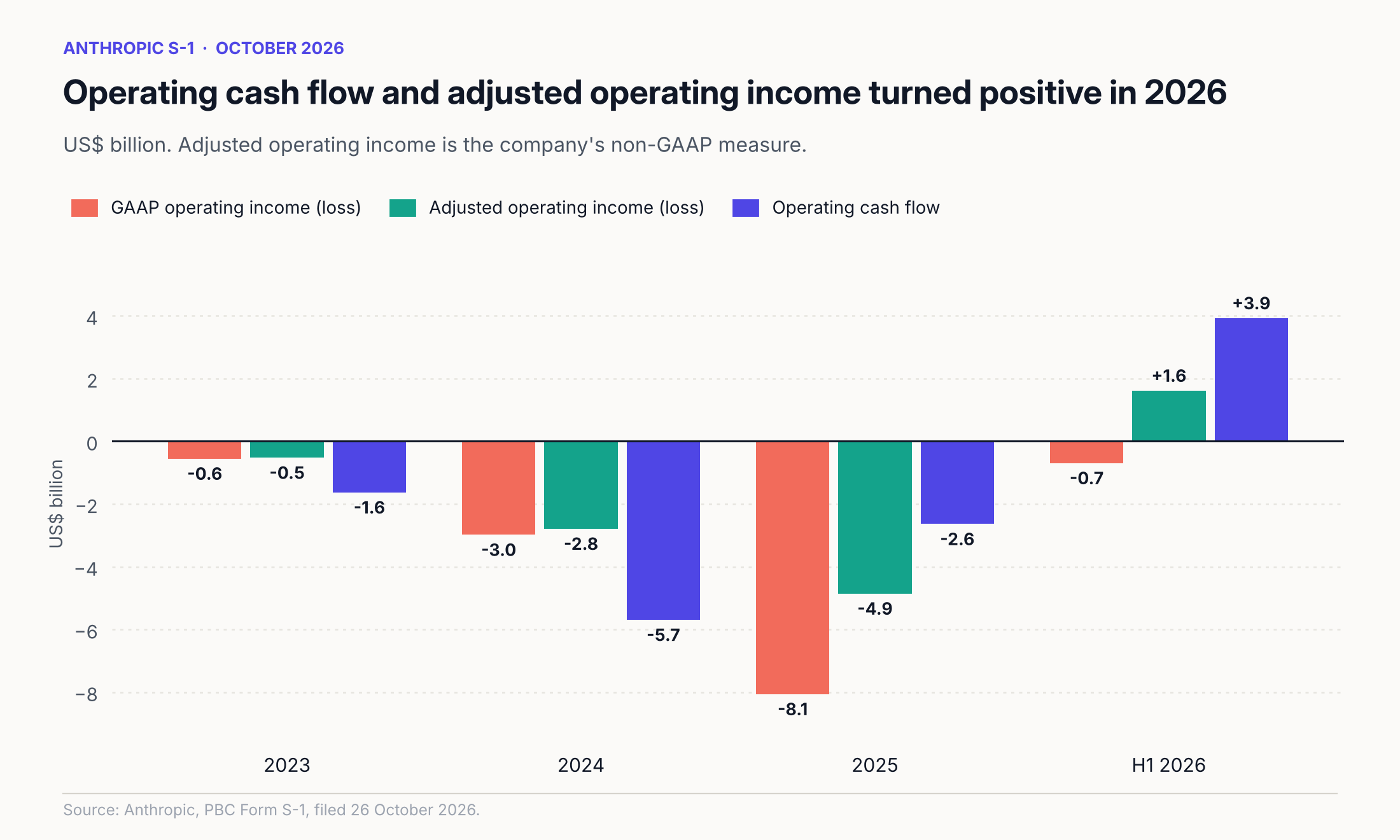
The company also reports adjusted operating income, a non-GAAP measure that excludes stock-based compensation, non-cash charitable contributions and the Bartz settlement. It was $1.6 billion in the first half of 2026, a 10% margin. Operating cash flow was $3.9 billion in the first half, after outflows of $2.6 billion in 2025 and $5.7 billion in 2024. The filing attributes part of the change to the timing of payments to vendors and receipts from customers, and the first half included $1.1 billion of interest income.
Stock-based compensation was $2.2 billion in the first half of 2026, 14% of revenue. Most restricted stock units vest only after a liquidity event. Had the IPO been completed on 30 June 2026, the company would have recorded a $2.9 billion catch-up charge on that date. A further $23.7 billion would be recognised over about 2.1 years, plus $3.1 billion for other awards over about 1.3 years. More units have been granted since.
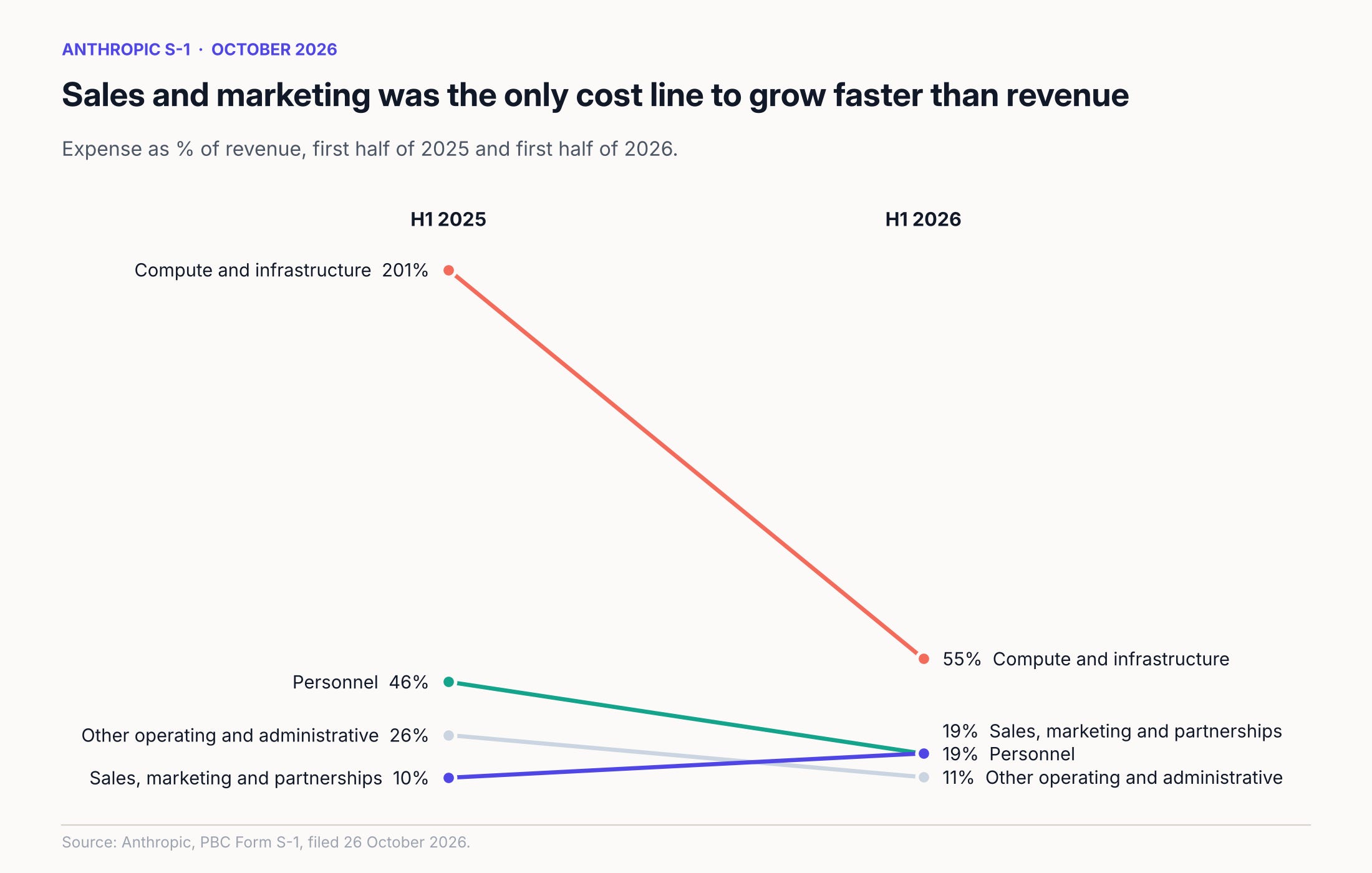
Sales, marketing and partnerships expense grew faster than revenue: it was $3.2 billion in the first half, 26 times a year earlier and 19% of revenue. Personnel expense was also $3.2 billion, 5.9 times a year earlier, and fell from 46% to 19% of revenue.
Compute commitments
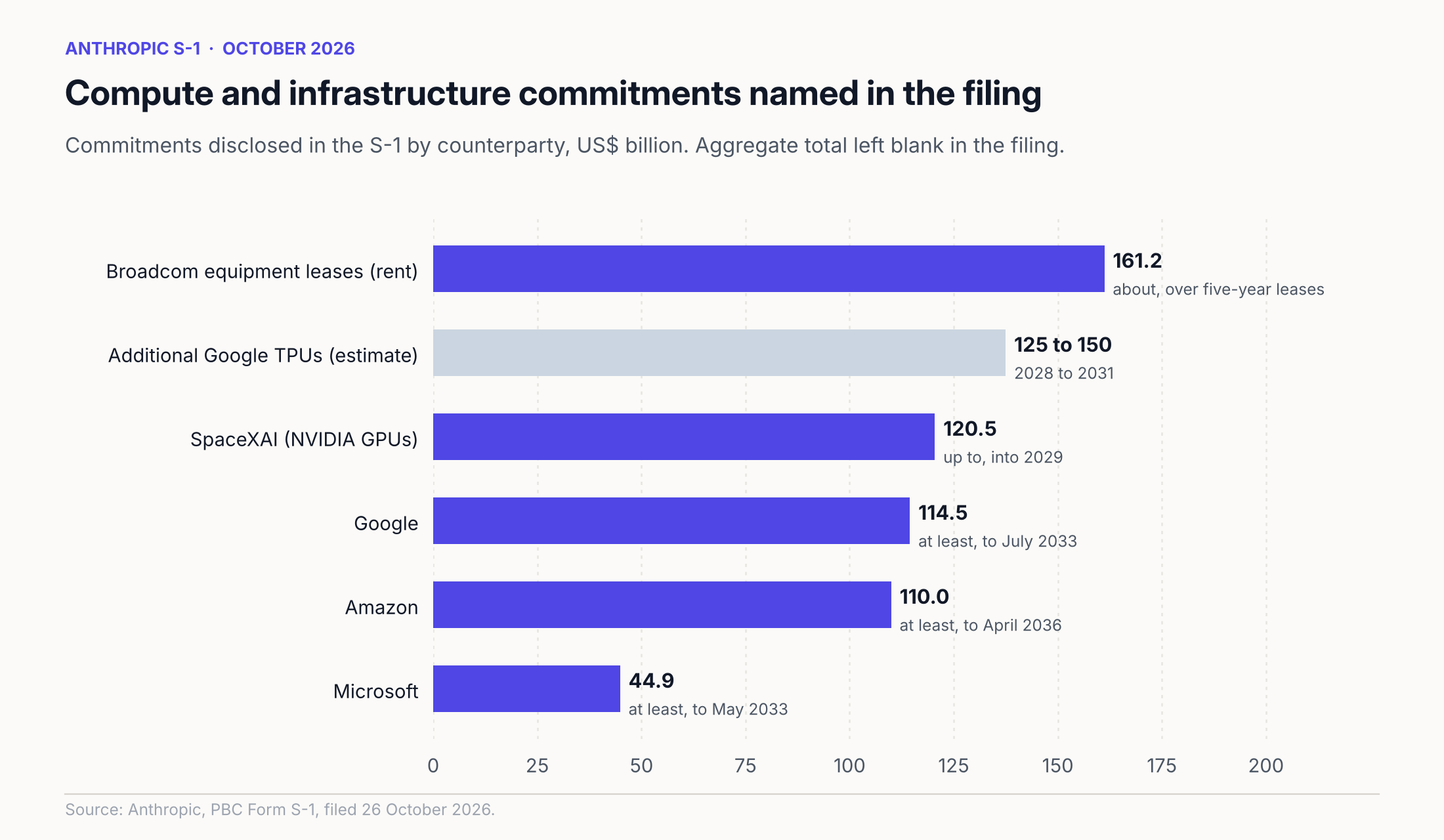
The SpaceXAI arrangements can be cancelled on 90 days’ notice after initial periods ending in early 2027. The Amazon and Google commitments apply regardless of actual usage. If Anthropic spends less, it pays the difference. The filing leaves the aggregate total of commitments blank. These commitments compare with revenue of $19.7 billion in the 12 months to June 2026 and cash and short-term investments of $131.7 billion at 30 June.
Concentration
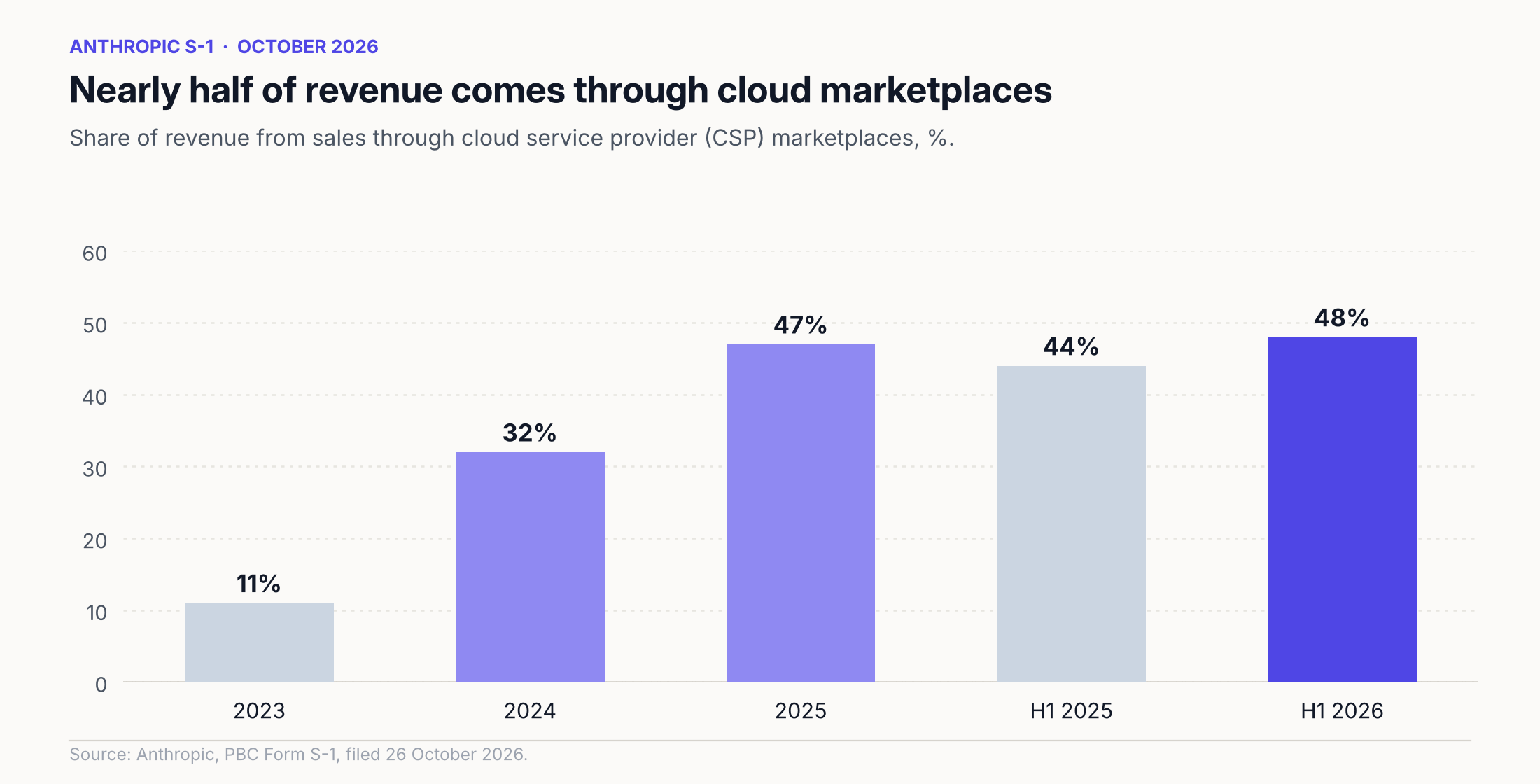
Distribution: 48% of first-half 2026 revenue came through cloud service provider marketplaces, run by Amazon, Google and Microsoft according to Fortune, which bill customers and pass payments to Anthropic. These marketplaces accounted for 58% of net accounts receivable at 30 June.
Customers: no customer exceeded 10% of revenue in the nine months to 30 September 2026. The top five accounted for about 25% over that period, 36% in the first quarter of 2026 and 21% in the third. Many top customers are not on long-term contracts, and Fortune notes that some are also competitors.
Partners in several roles: Amazon and Google are investors, compute suppliers and distribution channels. Because their shares are non-voting, they are not treated as related persons in the filing’s related-party section.
Government
Government agency contracts were about 1% of revenue in each period, but the dispute with the US government is broader than that figure. Earlier in 2026 the Department of War designated Anthropic a supply-chain risk to national security, and federal agencies were directed to stop using its technology. A district court in California largely ruled in Anthropic’s favour on 27 August 2026. On 25 September 2026 the D.C. Circuit Court of Appeals, in a 2-1 decision, upheld a separate designation under Section 4713. Anthropic has petitioned for a rehearing by the full court. The filing says it cannot predict the outcome.
Funding and investors
Anthropic had raised $141.1 billion of capital by 30 June 2026, including a $65 billion Series H round in May at a $965 billion post-money valuation. Financing inflows were $110.8 billion in the first half of 2026.
Amazon holds convertible notes with $6.2 billion of principal, carried at fair value within convertible notes payable of $108.6 billion at 30 June. They convert into about 1.84 billion non-voting Class N shares in connection with the IPO, at the lower of fixed prices of $2.09 and $5.05 per share and the IPO price. Amazon’s holding is capped at 12% of capitalisation and Google’s at 14.99%. Each can waive its cap. Notes that cannot convert under the cap roll over and convert in later quarters.
The company also has $77 billion of undrawn note purchase agreements:
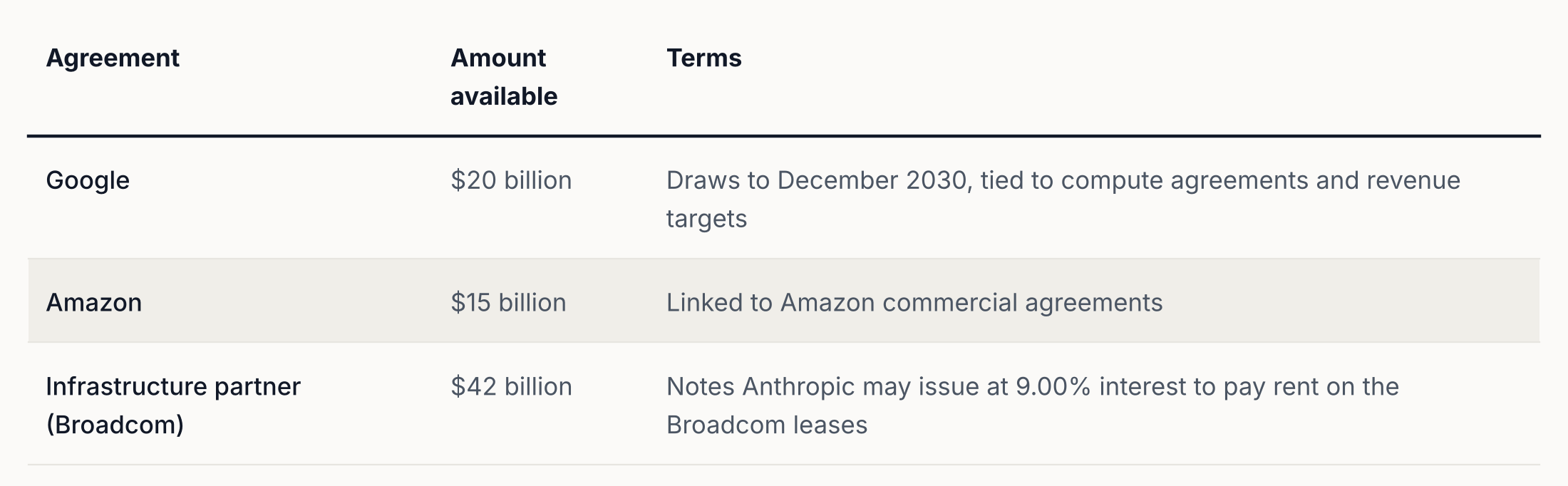
Google also has an option to buy up to $10 billion of Class N shares at the IPO price, which would reduce its note facility by the same amount.
Governance and share classes
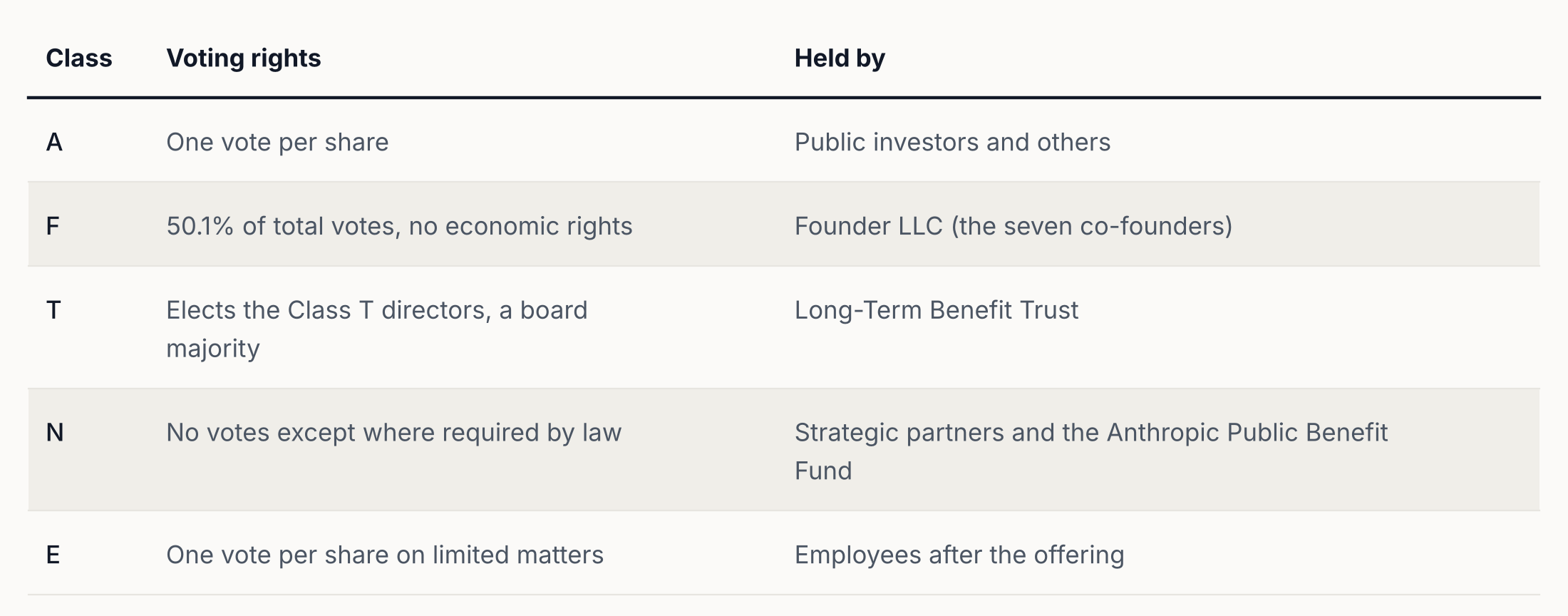
The Long-Term Benefit Trust has five trustees with no financial interest in the company. Anthropic will be a “controlled company” under Nasdaq rules, which exempts it from some board independence requirements. The filing states that this structure limits the influence of Class A shareholders, including over any change of control. Five of the co-founders are listed as selling stockholders.
The company has issued 846.8 million Class N shares, 5% of fully diluted shares, to the Anthropic Public Benefit Fund, a wholly owned subsidiary. The board may issue up to a further 2% each time the share price rises 50% from the previous threshold. The seven co-founders have pledged 80% of their personal equity to philanthropy.
Valuation
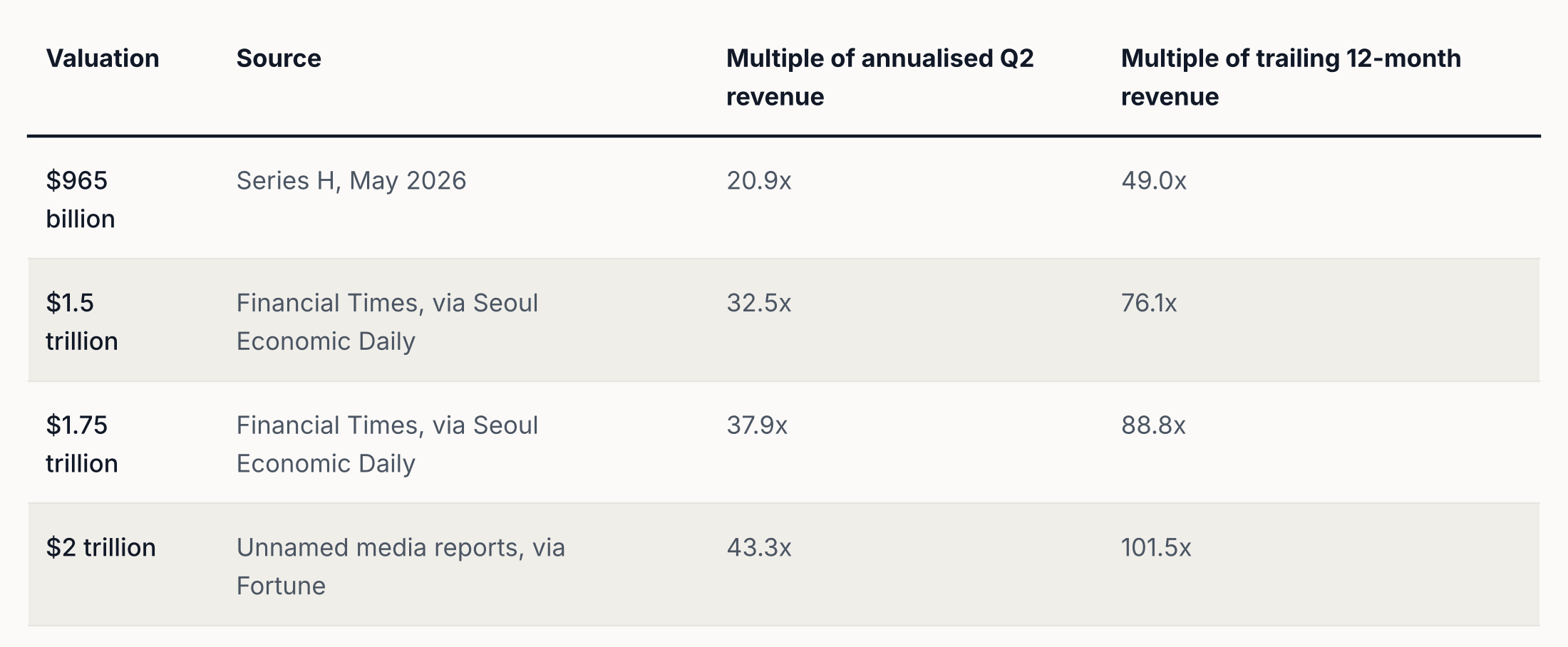
The filing gives no price. The table divides reported valuations by two revenue measures: second-quarter 2026 revenue multiplied by four ($46.2 billion), which assumes no further growth, and revenue for the 12 months to June 2026 ($19.7 billion).
Risk factors
The filing lists the risks the company considers most significant. They include:
Dependence on developing the most advanced models, and on securing enough compute.
Models that “may behave in unintended, misaligned, or autonomous ways, including by taking harmful actions that no user or third party directed”. The filing says these risks may increase as models are given more autonomy and access to outside systems.
Liability and regulatory action from harms linked to its models, with contractual protections and insurance that may be insufficient.
Concentration of revenue in a limited number of customers and distribution channels, some of which are also investors and suppliers.
A short operating history with growth that may not be representative.
A capital structure that limits Class A shareholders’ influence, and public benefit duties that may conflict with financial returns.
Not yet in the filing
Price range, number of shares offered and the size of the raise.
Revenue for the third quarter of 2026.
Run-Rate Revenue as of 31 October 2026, which is defined but left blank.
The aggregate total of compute and infrastructure commitments.
These are normally added in amendments before the shares are priced.
Notes on the figures
All financial figures are from the S-1 as filed on 26 October 2026, in US dollars. First-half and quarterly figures are unaudited.
Revenue per compute dollar, margins, growth multiples, the fair value total and valuation multiples are calculated from the filing’s figures.
Valuation ranges for the IPO are from press reports, not the filing. The $1.5 trillion to $1.75 trillion range is the Financial Times as reported by Seoul Economic Daily.